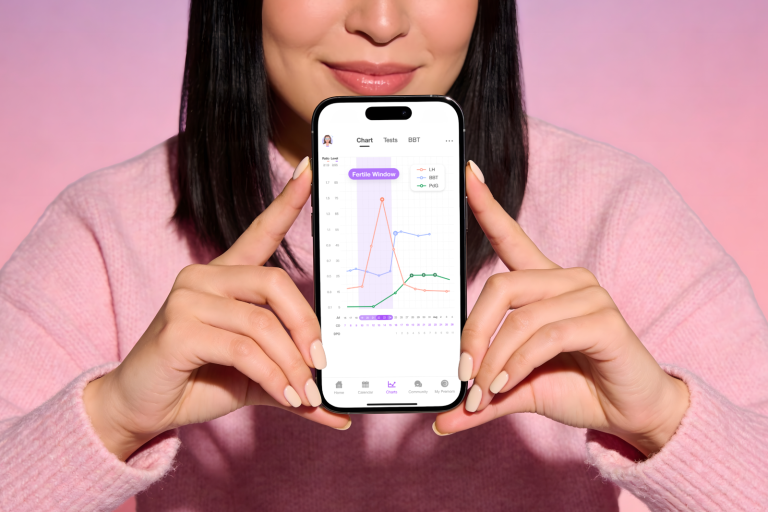

Seeing a faint line on an ovulation test can be confusing—does it mean ovulation is coming, or did you miss it? Understanding ovulation test results helps support better timing for intercourse and may improve your chances of getting pregnant. In this guide, we’ll break down what faint vs dark lines really mean and how to use ovulation predictor kits effectively.
Key Takeaways
- A faint line typically means lower levels of LH are present, but you likely haven't reached your surge yet.
- A test line as dark or darker than the control line may suggest ovulation could occur within about 24–36 hours.
- Tracking how a faint line becomes a dark one helps identify your fertile window.
- While they look similar, ovulation tests are not designed to confirm pregnancy.
- Tracking ovulation test results in an app may help make ovulation patterns easier to interpret.
What Does a Faint Line on an Ovulation Test Mean?
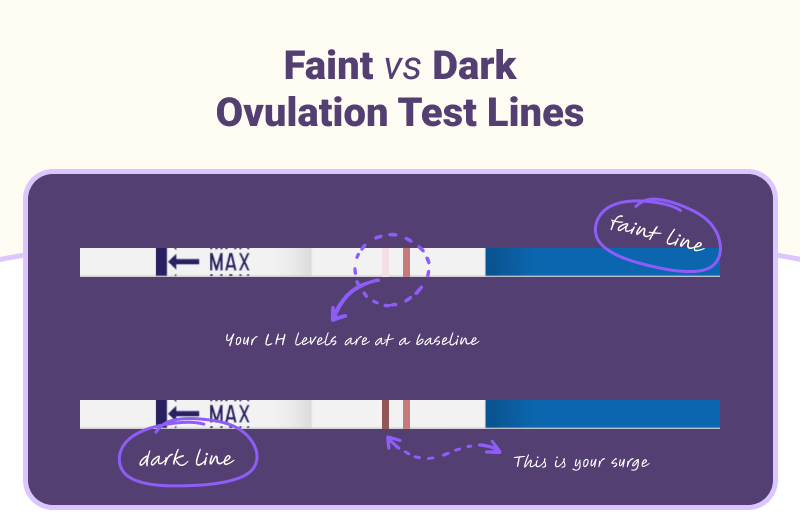
If you see a faint line in ovulation test results, it simply means that Luteinizing Hormone (LH) is present in your body, but it hasn't reached "peak" levels yet. Unlike a pregnancy test—where any line is a positive—ovulation test results are only considered positive when the test line is just as dark as, or darker than, the control line since we are looking for a build up of LH to trigger ovulation.
It is common to have low levels of LH in the system throughout the entire cycle. This is why you might see a faint line on ovulation test strips for several days before and after your actual surge happens.
Because LH levels change throughout the cycle, a single test result may not tell the full story. Looking at how your test lines change over several days can provide more context and help you recognize when your body is approaching a potential surge. Using a tracking app like Premom can make this easier by capturing each test result, assigning a numerical value to line intensity, and displaying your LH progression in a chart so you can more clearly see when your LH levels are rising toward a peak.
Faint vs Dark Lines on Ovulation Tests (Complete Guide)
What does a dark line and a faint line mean on an ovulation test?
- Faint Line: Your LH levels are at a baseline. You are likely not in your most fertile window yet.
- Dark Line: This is your surge. It indicates your body is preparing to release an egg.
Faint vs dark ovulation test lines: quick comparison
| Result Type | What It May Mean | Fertility Timing |
|---|---|---|
| Faint line | LH is present but below surge | Not peak fertility yet |
| Dark line | LH surge may be occurring | Ovulation may occur soon |
| Line fading | LH levels dropping after surge | Ovulation may have already occurred |
Do ovulation test lines get darker closer to ovulation?
For many women, yes! You may notice a staircase effect where the lines get progressively darker over 2–3 days. However, some women have a rapid surge where the line goes from very faint to very dark in just a few hours.
Does a Faint Line Mean Ovulation Is Coming or Passed?
Does a faint line mean ovulation is coming?
A faint line can mean your surge is just beginning to build. If you have been testing daily and notice the line is darker than yesterday (but still lighter than the control), ovulation is likely approaching in the coming days.
Does a faint line mean ovulation has already happened?
It could! Once your LH surge ends, your levels drop back to baseline very quickly. If you had a dark line yesterday and a faint line in ovulation test results today, you have likely already reached your peak.
What should you do if you see a faint line on an ovulation test?
If you see a faint line, it may be helpful to continue testing once or twice daily for a few more days to watch for changes in line intensity. Tracking patterns over several days can help you identify when your LH levels are rising toward a potential surge. Logging your results in an ovulation tracking app like Premom, especially when using the app together with ovulation test strips such as easy@Home, may help you more easily track LH line progression and notice patterns over time.
Can You Get Pregnant with a Faint Ovulation Test Line?
Yes, but the timing is tricky. Because sperm can live for up to two to five days, having sex when you see a faint line approaching your surge can result in pregnancy. However, a faint line itself does not signal your most fertile day.
Can ovulation tests detect pregnancy?
We often get asked: "Can an ovulation kit detect pregnancy?" While LH and the pregnancy hormone (hCG) are molecularly similar, and an ovulation test may pick up the pregnancy hormone, it is not a reliable way to check for pregnancy. If you think you might be pregnant, a very faint line on a home pregnancy test is the only way to be sure.
Ovulation tests vs pregnancy tests: what’s the difference?
Ovulation tests detect luteinizing hormone (LH), which rises before ovulation.
Pregnancy tests detect human chorionic gonadotropin (hCG), which is produced after implantation.
Although these hormones are similar, ovulation tests are not designed to confirm pregnancy and may produce misleading results if used for that purpose.
How Ovulation Tests Work (LH Hormone Explained)
Ovulation predictor kits (OPKs) work by detecting the surge of Luteinizing Hormone. This hormone is the final trigger that tells your ovary to release an egg.
How to Read Ovulation Test Results Correctly
Two lines on an ovulation test and one lighter
If you see two lines on an ovulation test, one lighter, the test is negative. For a positive result, the test line needs to be as dark as or darker than the control line; however, it is possible to ovulate with a line that is slightly lighter than the control line. It will take the app at least 1 cycle to recognize this as a peak if you are new to the app.
Constant faint line on ovulation test
It is very common to have a constant faint line on ovulation test strips. This just means your body is producing its normal, baseline amount of LH.
Understanding your LH peak
As you continue testing, you may notice a progression from low → high → peak → back to lower levels. The LH peak is usually the darkest test line in this sequence and reflects your highest LH level during the cycle.
For many individuals, LH levels rise before the peak and fall shortly after. Ovulation often occurs after this peak, which is why observing changes across multiple tests can provide more context than relying on a single result.
Tracking this progression over time can be challenging when relying on individual tests alone. Using ovulation test strips like easy@Home together with a tracking app like Premom may help simplify this process by organizing your results in one place, comparing line intensity across days, and helping you better estimate when your LH peak and fertile window may occur so you can time intercourse more effectively.
Why You Keep Getting Faint Lines on Ovulation Tests
If you never see a dark line on an ovulation test, you’re not alone. This can happen for several reasons, including timing, testing habits, or natural variations in hormone levels. In some cases, it may also mean that your LH surge is very short or harder to detect.
- Testing too early or late: You may be missing a short LH surge that happens between tests.
- Diluted urine: Drinking too much water before testing can lower LH concentrations in your sample.
- Rapid LH surge: Some individuals experience a surge that rises and falls quickly, making it easy to miss.
- Hormonal patterns (e.g., PCOS): Some people may have higher baseline LH levels or multiple LH rises, which can make it harder to identify a clear peak.
In some cycles, LH levels may rise and fall without leading to ovulation, which can also result in repeated faint lines. If this happens repeatedly, tracking over multiple cycles or using additional methods may help provide a clearer picture of your ovulation patterns.
Overcoming the "Information Overload" of TTC
We know that when you first look at tracking, like LH levels and ovulation test results, it can feel a little overwhelming. You might worry that tracking is too complex or takes a long time to learn.
Premom is designed to change that. We believe you shouldn't need a medical degree to understand your own body. The app removes the stress of multi-step data entry by:
- Simplifying the Learning Period: Premom’s AI begins analyzing your specific LH patterns from your very first cycle.
- Taking Away the Guesswork: You don't have to wonder "Is this a peak?" Premom highlights your highest fertility days clearly on your screen.
- One-Step Entry: Just snap a photo of your ovulation test strips, and the app does the rest.
When Is the Best Time to Test for Ovulation?
For more consistent results, testing between 10 AM and 8 PM is recommended. Avoid using your first morning urine, as LH usually builds up in your system during the day.
Premom Advantage: Track Line Progression with AI
Interpreting ovulation test results consistently can be easier when patterns are tracked over time. With the Premom app, you can scan ovulation test strips using your phone’s camera. The AI test reader assigns a numerical value to the darkness of the test line, creating a clear map of your fertile window.
FAQs About Faint Lines on Ovulation Tests
Yes, an ovulation test is typically considered positive when the test line is as dark as or darker than the control line. However, some people may ovulate even if the test line is slightly lighter. If you’re new to the app, it may take at least one full cycle of tracking for your patterns to be recognized and your peak to be identified more accurately.
Ovulation typically occurs 24 to 36 hours after your first positive (dark) test.
Yes, seeing a faint line is common and typically reflects baseline LH levels that are present throughout the menstrual cycle.
Sometimes, a positive ovulation test may detect hCG, which can lead to a positive result during early pregnancy. However, they are not designed to confirm pregnancy. For more reliable results, use a home pregnancy test or consult a healthcare provider.
Optimize Your Fertile Window
Understanding the difference between a faint line and a dark one is the first step in taking control of your fertility. By using best ovulation test strips and tracking your results in the Premom app, you can stop guessing and start timing your journey with confidence.
References
Johnson, S., Stanford, J. B., Warren, G., Bond, S., Bench-Capon, S., & Zinaman, M. J. (2020). Increased Likelihood of Pregnancy Using an App-Connected Ovulation Test System: A Randomized Controlled Trial. Journal of Women's Health, 29(1), 84–90. https://doi.org/10.1089/jwh.2019.7850 Cited by: 40
Su, H., Yi, Y., Wei, T., Chang, T., & Cheng, C. (2017). Detection of ovulation, a review of currently available methods. Bioengineering & Translational Medicine, 2(3), 238–246. https://doi.org/10.1002/btm2.10058 Cited by: 319
American College of Obstetricians and Gynecologists. (2023). Fertility awareness-based methods of family planning. https://www.acog.org/womens-health/faqs/fertility-awareness-based-methods-of-family-planning
Holesh, T. B., Bass, A. S., & Lord, M. (2023). Physiology, Ovulation. StatPearls Publishing. https://www.ncbi.nlm.nih.gov/books/NBK441996/
Mayo Clinic Staff. (2023). How to use ovulation predictor kits. https://www.mayoclinic.org/healthy-lifestyle/getting-pregnant/expert-answers/ovulation-signs/faq-20058000