| "Helping women track their ovulation in a smarter way" |

The LH surge is the sharp rise in luteinizing hormone (LH) that triggers ovulation within 24–36 hours. The LH peak is the highest point of that surge, typically occurring 24 hours before egg release. Ovulation usually happens within 24–36 hours of the LH surge beginning and about 24 hours after the LH peak. The best time to have sex is two days before ovulation day and the day of ovulation itself.
Most people understand that a positive ovulation test means something is happening, but fewer know the difference between an LH rise, an LH surge, and an LH peak, or why that distinction changes when you should act. Timing sex after the peak has already passed means you’ve potentially missed your window. Reading the whole pattern, not a single positive line, is what helps you time a cycle well.
Key takeaways
- The LH surge is a sharp rise in LH that begins 24–36 hours before ovulation. The LH peak is the highest point within that surge, your ovulation test shows “peak” (or darkest/equal line) at this point.
- Ovulation follows the LH peak by about 24 hours, and the egg stays viable for about 24 hours after that.
- The best time to have sex is the two days before ovulation (when LH surge is highest and peaked), and the day of ovulation itself
- A surge does not always mean ovulation happened. Adding basal body temperature (BBT) can suggest whether it likely did.
- Does LH stay high if the egg is fertilized? No, LH drops after ovulation regardless.
What is an LH surge?
Ovulation is the main event of the menstrual cycle, when a mature egg is released from the ovary. Luteinizing hormone (LH) is the hormone responsible for triggering this to happen each cycle. Once your LH reaches its highest level, known as the LH peak, ovulation occurs within the next 24–36 hours. After the egg is released, it lives only for about 24 hours. Sperm, by contrast, can survive up to 5 days in the female reproductive tract, which is why timing intercourse before the peak, not just on the day of it, matters a lot.
Ovulation timing varies a lot from person to person. Most believe they ovulate on cycle day 14, but according to a study published in The BMJ (Wilcox et. al., 2000), in only about 30 percent of women is the fertile window entirely within days 10 to 17. Using ovulation predictor kits (OPKs) helps you understand your unique hormone patterns and ovulation day rather than guessing from a calendar.

LH surge meaning: what does LH surge mean?
The surge is the sharp climb in LH that happens before ovulation. On an ovulation test, like easy@Home ovulation strips, it shows up as a test line that becomes as dark as or darker than the control line. That positive is your signal that ovulation is approaching.
What does LH surge indicate?
The LH surge typically indicates that ovulation occurs within 24–36 hours of the surge beginning and about 24 hours after the peak. It is one reliable advance signal of ovulation available without a clinical ultrasound. Detecting the surge in LH gives you a practical action window: begin or continue having sex when the surge appears.
Does LH always surge before ovulation?
Yes, ovulation cannot occur without an LH surge. The surge is the physiological trigger. However, not every LH surge results in ovulation. In some cycles, particularly in women with PMOS (formlery known as PCOS) or during periods of significant hormonal disruption, an LH surge can occur without the follicle rupturing and releasing an egg. This is why combining OPK tracking with Basal body temperature (BBT) charting can provide more clarity than only using ovulation test kits alone.
Can I have an LH surge and not be ovulating?
Yes. This is an anovulatory cycle, where LH surges but ovulation doesn’t follow. It’s more common than many people realize, and can come with PCOS, stress, illness, perimenopause, or large weight changes. One way to tell if ovulation likely occurred (not just that LH surged) is a sustained BBT rise of 0.2–0.5°F over several consecutive days after the surge.
Low, high, and LH peaks: what your ovulation test reading means
Your ovulation test readings map to three fertility levels. The Premom app shows these as Low, High, and Peak, which is the same story your test line is telling you day to day. These lines are the key to understanding how to time conception better.

Low reading (low fertility):
Early in your cycle, right after your period, LH sits at a low baseline while your body prepares for ovulation. Your test may show no line or a very faint one. Conception odds are low here, and you are not yet in your fertile window.
High reading (high fertility):
As you approach ovulation, your LH levels will start to rise and continue to increase until you reach the LH peak, which occurs just before ovulation. During this phase, your ovulation test lines will become progressively darker, eventually reaching a point where the test line is as dark or darker than the control line indicating you have likely entered your fertile window. Conception chances at this point are good because sperm can survive up to 5 days within the fallopian tubes. Begin having intercourse every other day to maximize your chances of conception.
Peak reading (peak fertility):
Your peak is when LH reaches its highest point and your test shows its darkest line, as dark as or darker than the control. This LH surge triggers the release of an egg, which typically occurs about 24 hours later. The day before your LH peak, the peak day itself, and the day after (when ovulation occurs) are the three days with the highest chance of getting pregnant in your cycle.
At Premom, we have made everything automatic and straightforward with an automatic digital ovulation test reader. After taking an ovulation test, you only have to snap a picture of your ovulation test using the in-app camera. The app then automatically calculates your LH results. You can view your LH hormone progression using Premom’s ‘chart view’ to find your fertile window and peak fertility days easily!

High fertility vs peak fertility: what’s the difference?
High and peak fertility are both important for timing intercourse to increase your chances of pregnancy. When using ovulation tests, your results will continue to darken indicating that you are in your fertile window and your body is ramping up its preparation for ovulation. During this time, sperm can survive for several days and may still result in a pregnancy if you have sex.
On the other hand, peak fertility is a very specific period when you are at your most fertile. This occurs during the two days leading up to and including the day of ovulation. Peak fertility represents the optimal time for conception and is often accompanied by fertile cervical mucus that looks like egg whites.
In the simplest of terms, for LH surge vs LH peak, high fertility means your body is getting ready to ovulate soon, and peak fertility is your body’s way of saying, “Now’s the time!”
LH rise vs LH surge vs LH peak: what’s the difference?
Reading the three stages together tells you what your test result means each day and what to do about it. An LH surge and peak can also fall on the same day for some people. See our guide to gradual vs rapid LH surges for how that plays out.
| Stage | What it means | What your OPK shows | Action |
| LH rise | LH climbing from personal baseline toward the surge | Test line getting darker but lighter than the control | Start having sex every 1-2 days |
| LH surge | The rise into your peak, ovulation is approaching | Test line equal to or darker than control (positive) | Have sex today and tomorrow |
| LH peak | Highest point of the surge — ovulation about 24 hours away | Darkest test line of the cycle | Highest priority for sex |
| Post peak | LH falling back toward personal baseline | Test line lightening after peak | Ovulation window closing |
It’s important to note that an LH surge and peak can coincide at the same time or on the same day. Learn more about gradual vs rapid LH peaks.
What is an LH rise?
The LH rise is the gradual increase in LH that precedes the surge. During the rise, your LH is climbing from its follicular baseline toward the threshold that triggers the surge, but it hasn’t peaked yet. On an OPK, the test line is getting progressively darker from day to day, but it hasn’t yet reached “as dark as or darker than the control line.” The rise tells you the surge is approaching, the surge itself is the sharp escalation that signals ovulation is imminent.
Does an LH peak mean you already ovulated?
No. The peak comes before ovulation, not after. Ovulation typically follows your peak by about 24 hours. So when you see your darkest line, the egg has not been released yet. That is the right moment to prioritize sex.
Can I ovulate the same day as the LH peak?
It’s possible, though less common. Most research indicates ovulation follows the LH peak by about 24 hours, meaning the day after the peak is the most likely ovulation day. Some women with rapid LH surges may ovulate closer to the peak itself. This is why having sex on both the peak day and the day after gives the best coverage.
LH surge and ovulation timing: how long after the surge do you ovulate?
How long after the LH surge do you ovulate?
Ovulation typically occurs 24–36 hours after the LH surge begins and about 24 hours after the LH peak. This is the core timing window most fertility specialists reference when advising couples trying to conceive. The egg is only viable for about 24 hours after release, so the clock starts ticking the moment ovulation happens, not the moment the surge is detected.
When do you ovulate after an LH surge?
The most common ovulation window is 24–36 hours from the start of the surge and about 24 hours from the peak. For most women, this means:
- Day of positive OPK: Surge is happening — ovulation is approaching
- Day after positive OPK: Most likely ovulation day for most women
- Two days after positive OPK: Possible for some women with longer surges
Having sex on both the day of the positive OPK and the following day covers the most likely ovulation window for most people.
How long after the LH peak do you ovulate?
Ovulation follows the LH peak by approximately 12–24 hours for most women (Park et al., 2007). The peak is identified as the highest point of the LH curve, after which LH begins declining. If you can identify your peak, the next 12–24 hours is your most precise ovulation window.
LH peak and ovulation: are they the same day?
Not usually. The LH peak typically precedes ovulation by about 24 hours. They can occasionally fall on the same calendar day depending on when the peak occurred and how quickly the follicle responds, but treating them as separate events separated by 24 hours is a more accurate model for timing purposes.
How long does the LH surge last?
The LH surge typically lasts 12–48 hours from start to finish. Some women have rapid surges that peak and resolve within 12 hours, which is why they might only catch one positive OPK despite testing daily. Others have slower surges lasting up to 48 hours, during which multiple positive tests appear. The duration of the surge doesn’t change the timing of ovulation, what matters is identifying the peak.
How long does LH stay elevated after ovulation?
LH drops back to baseline within 24–48 hours after ovulation. Once the follicle ruptures and the egg is released, the LH signal is no longer needed, and levels fall quickly. On Premom’s LH chart, you’ll see a clear drop from peak to baseline. This descending line is actually useful in that the peak has passed and ovulation has likely occurred.
Does LH drop on ovulation day?
Yes, LH begins falling as soon as ovulation occurs. If you’re testing daily and see your OPK line lightening after a clear peak, that’s a good indicator that ovulation has happened. A declining test line after peak is not a problem, it’s the expected and correct pattern.
What does a positive ovulation test actually mean?
A positive ovulation test means the LH surge has been detected in your urine — the test line is as dark as or darker than the control line. It means ovulation is likely in about 24-36 hours. It does not mean you’ve already ovulated. A positive result is your signal to act — have sex today and tomorrow for the best conception timing.
What does it mean when an ovulation test is positive?
It means your LH has risen enough to meet or exceed your test’s detection threshold, indicating the surge is underway. For qualitative strips like easy@Home ovulation predictor kits, this means the test line equals or exceeds the control line in darkness. For Premom’s quantitative ovulation tests, the app identifies your personal peak based on your individual numerical trend, more precise than line comparison alone.
Do ovulation tests tell you if you’ve already ovulated?
No. OPKs detect LH in urine, they detect the surge that precedes ovulation, not the event itself. Once LH begins dropping after your peak, the test line lightens, but that declining line is not a retroactive confirmation of ovulation, it just indicates the surge has passed. BBT tracking is the tool to tell if ovulation likely occurred. A sustained temperature rise of 0.2–0.5°F over 3+ consecutive days after your LH peak may suggest ovulation occurred.
If the ovulation test is positive, can I be pregnant?
An ovulation test detects LH, not pregnancy. However, the hCG hormone produced in early pregnancy has a similar molecular structure to LH, and at high enough concentrations, it can trigger a positive OPK. So a positive OPK result in the luteal phase, particularly after a confirmed LH peak and in the absence of a new surge, could potentially reflect rising hCG. It is not a reliable pregnancy test, but it’s a pattern worth noting. Use a pregnancy test to confirm.
Can you get a positive ovulation test and not ovulate?
Yes, this is one of the most important nuances to understand. A positive OPK tracks an LH surge, not ovulation itself. In anovulatory cycles, the LH surge fires but the follicle doesn’t rupture and release the egg. This is more common in PMOS, where LH can remain elevated or surge without triggering ovulation.
Positive ovulation test 2 days in a row: what does it mean?
It’s possible to experience multiple days of high LH levels, this is called a gradual onset LH surge. With this type of surge, you may see multiple positive results for more than one day before reaching your actual LH peak — your last, highest level. The last, darkest result is your true peak day. Keep testing daily until you see the test line begin to lighten, that lightening marks the day after your peak, and your most likely ovulation day.
Can You Have More Than One Positive Ovulation Test Each Cycle?
It’s possible to experience multiple days of high LH levels, but it’s the last highest LH level that will successfully trigger ovulation and be considered your peak day.
Women who have multiple positive results have a gradual onset LH surge. With this type of surge, you may see multiple positive ovulation test results for more than one day before reaching your ultimate LH peak day, your last, highest level of LH.
Other women have what is called a rapid onset LH surge that peaks quickly within as little as a few hours. This means you may only see one positive ovulation test despite multiple days of testing. If you are new to testing or have been testing and have been unable to find your LH peak, you may benefit from testing twice daily as you could have a rapid onset surge and be missing your peak!
When is the best time to have sex after an LH surge?
Are you more fertile before or after an LH surge?
Before, specifically in the 1–2 days immediately before and on the day of the surge. Because sperm can survive up to 5 days in fertile cervical mucus, having sperm already present when the egg is released increases fertilization chances. The fertile window is the 5 days before ovulation plus ovulation day, with peak fertility on the day of the surge and the day after.
Are you fertile 2 days after LH peak?
Very unlikely. By 2 days after the LH peak, ovulation has already occurred and the egg’s 12–24 hour viability window has closed. If you haven’t had sex before this point, the opportunity for conception in that cycle has passed. This is why acting on the surge gives you the best timing, starting intercourse when the surge begins rather than waiting for ovulation itself.
Are you fertile 2 days before the LH surge?
Yes. The 2 days before the LH surge are within your fertile window. Sperm deposited 2 days before the surge peaks can survive until ovulation occurs. Having sex in the 2–3 days before your positive OPK, and continuing through the day after, gives you the broadest and most effective coverage of the fertile window.
When during the LH peak is best to conceive?
The best time is as soon as you detect a positive OPK, don’t wait for the “darkest” line. Have sex on the day of the positive test and the following day. The day of the surge and the day after together represent the window when ovulation is most likely to occur.
When to have sex after a positive ovulation test
Have sex on the day of the positive OPK and the day after. Don’t wait — LH is surging, and ovulation is 12–36 hours away. If you can, begin having sex every 1–2 days during your predicted fertile window, in addition to during your LH surge plus ovulation day.
When to take an ovulation test and how to read it
What time of day is LH highest?
LH levels are typically highest between late morning and early afternoon. which is why testing between 10 am and 8 pm is generally recommended for catching the surge. LH rises are often detected in the bloodstream in the early morning hours but take time to appear in urine, meaning the surge may not show up on a urine OPK until later in the day.
When to take an ovulation test: morning or night?
Neither morning nor evening alone is optimal for everyone, but if you can only test once daily, testing between 10 am and 8 pm is the most commonly recommended window. If you’re concerned about missing a short surge, testing twice daily, once in the morning and once in the early afternoon, may reduce the risk of missing your peak. Avoid testing first thing after waking if you’ve reduced your fluid intake: moderate hydration (not excess) helps ensure LH concentration in urine is neither too diluted nor too concentrated.
Best time to take an ovulation test
The best time to take an ovulation test is in the late morning to early evening, between 10 am and 8 pm, when LH concentrations in urine are most likely to reflect the surge accurately. You can test around the same time each day for consistency. Reduce fluid intake for about 2 hours before testing to avoid diluting the sample.
What can affect your ovulation test result?
Several factors can affect OPK results:
● Drinking a lot of fluid before testing dilutes LH and can give a false negative.
● Testing too early in the day can miss a surge that has started but not yet reached your urine.
● PCOS can keep baseline LH high, which makes a true surge harder to pick out.
● Some medications, including fertility drugs that contain hCG or LH, can affect results.
● Expired or poorly stored tests can give unreliable results.
LH surge chart: what your Premom OPK progression looks like
Premom is a free fertility tracking app that reads your easy@Home ovulation test strip and converts the line darkness into a numerical LH ratio, plotting every reading as a continuous daily curve. On that curve, you can see:
- The gradual LH rise from baseline (climbing line)
- The sharp surge (steep upward spike)
- The peak (highest data point on the curve)
- The decline (dropping line as LH returns to baseline)
For many women, this pattern is immediately recognizable once you’ve tracked 2 to 3 cycles. For anyone with PCOS, a plateau surge, or multiple peaks, seeing the numbers is clearer than comparing line darkness by eye.

Does LH stay high after ovulation if pregnant?
No. LH drops after ovulation regardless of whether fertilization occurs. The common belief that a sustained positive OPK in the luteal phase signals pregnancy is a misconception. LH returns to baseline within 24–48 hours after the peak, whether or not the egg was fertilized. What can cause a positive OPK later in the luteal phase is hCG (the pregnancy hormone), which has a similar structure to LH. If you see a positive OPK test 10–14 days after your confirmed peak, it may be worth taking a pregnancy test.
Does LH surge always mean ovulation?
No, and this is important. The LH surge is the trigger for ovulation, but the follicle doesn’t always rupture. In anovulatory cycles, the surge occurs but the egg isn’t released. This is particularly relevant for women with PMOS, where high baseline LH and disrupted follicle development can mean surges fire without resulting in ovulation. BBT tracking after the surge gives you available at-home evidence that ovulation actually likely occurred.
What are signs you have already ovulated?
Signs that ovulation has likely occurred:
- Your OPK test line was clearly positive and is now lightening back toward baseline
- Your BBT has risen by 0.2–0.5°F and stayed elevated for 3+ consecutive days
- You may have noticed mild one-sided pelvic pain (mittelschmerz) around your peak
- Cervical mucus has shifted from egg-white to thicker, cloudier, or drier
- A positive PdG test in the luteal phase
None of these alone confirms ovulation — but together, they provide meaningful post-ovulation evidence that an egg was likely released.
Is it normal for LH levels to go up and down before ovulation?
Yes, and understanding this is key to identifying your true peak. Multiple peaks during the surge are a recognized pattern. Women with a gradual onset surge may see several ups and downs in test line darkness over a few days before reaching the final highest level. Women experiencing stress, illness, or hormonal fluctuations may also see dips during the rise. The rule to follow: the last highest level is the true peak day. Keep testing daily until you see a clear decline back toward baseline.
3 Common Types of LH Surge Patterns
Not every surge looks the same. Understanding your pattern helps you interpret your results correctly across multiple cycles.
Type 1: Single peak
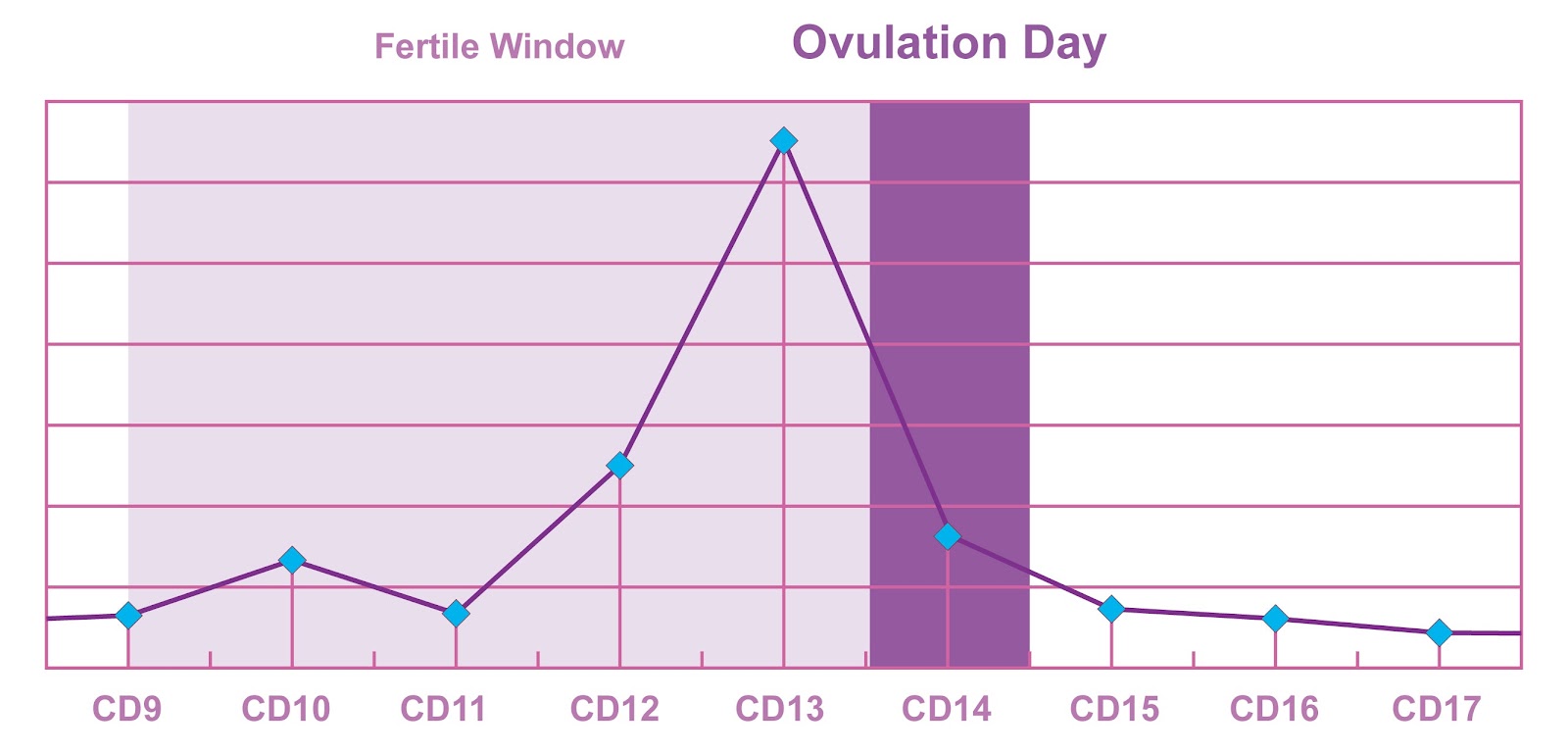
Some women have a steady rise and peak. In terms of ovulation tests, you will see the test line gradually getting darker, rising to your peak, and then getting lighter, descending back to baseline. This is one of the more straightforward patterns to interpret.
Type 2: Plateau
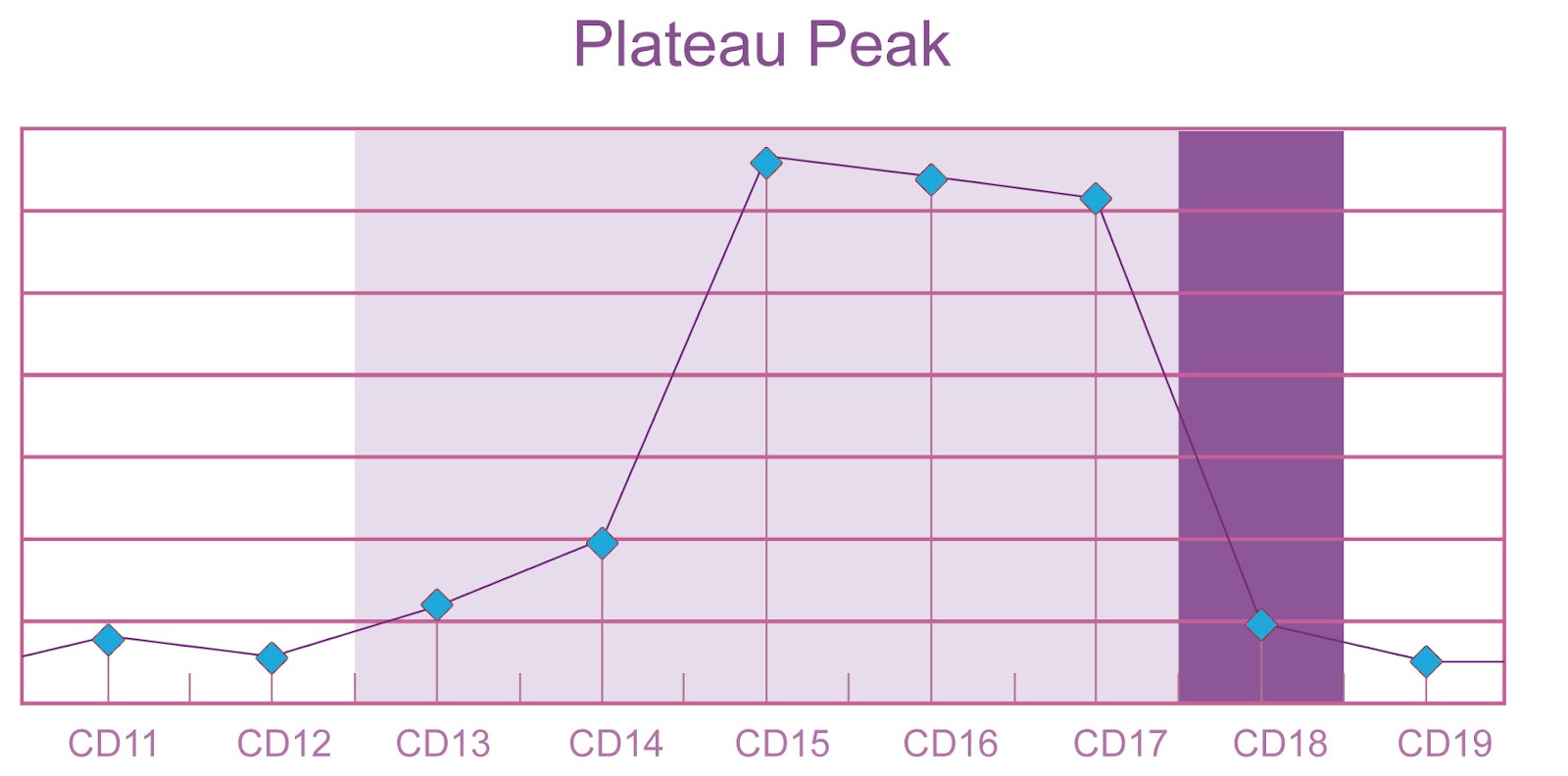
There is a second type of gradual onset, which is more of a “plateau.” In this case, you see consistently positive results with similar darkness before ovulation. Not one line seems to stand out more than other lines. In this case, we recommend you keep tracking until you see the test line begin to lighten again. That day is your most fertile day, and the last positive of that cycle is your peak day.
Type 3: Multiple peaks

Several ups and downs during the rise, multiple apparent peaks before the final highest point. This can be caused by stress, illness, hormonal fluctuations, or it may simply be your normal pattern. Apply the same rule: the last highest level is the true peak. Keep testing until LH returns clearly to baseline.


Which reading is your true peak?
Your last and highest LH reading is the one that signals ovulation is about to happen. Once you think you have found your peak, keep testing daily until your levels drop back toward baseline, so you know it was the real one.
What is multiple follicular stimulation?
If you have ever seen two peaks or a second surge in one cycle a couple of days apart, you may have had multiple follicular stimulation. To conceive, a follicle has to rupture and release its egg. Sometimes the body releases the follicle but it does not rupture, so no egg comes out. The body responds by releasing a second follicle a few days later, which can look like a second peak on your test.
No matter your pattern, every body is different and even your own cycles can vary. The most useful thing you can do is learn your pattern through steady tracking.
When you can’t find your LH peak
If you’ve been tracking for a few cycles and still can’t identify a clear peak, a few things may help:
- Test twice daily — particularly between 10am and 8pm. Rapid-onset surges can appear and resolve within hours.
- Use quantitative strips — Premom’s quantitative LH strips show your numerical level (5–65 mIU/mL), making subtle surges visible that might look like “not quite positive” on a qualitative strip.
- Compare cycles — the Premom app stores your LH curve across cycles, letting you see whether you’re getting consistent patterns or highly variable results.
- Schedule a virtual consultation — if you’ve tracked for 3+ cycles and still can’t find a LH surge, Premom’s in-app fertility expert consultations can help interpret your data and recommend next steps.
No matter what pattern you might have, remember that every woman is different. Even cycles can be different! The best way to get pregnant fast is to learn your patterns through education and smart tracking.
Key terms explained
LH (Luteinizing Hormone): A reproductive hormone produced by the pituitary gland. In women, its primary role is triggering ovulation by signaling the dominant follicle to release its egg.
LH rise: The gradual increase in LH from baseline levels as the body builds toward the surge. This is the “climbing” phase visible on a Premom LH curve before the surge begins.
LH surge: The sharp, rapid spike in LH, from baseline to peak levels, that triggers ovulation within 24–36 hours. This is what a positive ovulation test detects.
LH peak: The single highest point of the LH surge in a given cycle. After the peak, LH drops back toward baseline. The peak is the most fertile point; ovulation typically follows within about 24 hours.
Anovulatory cycle: A cycle where menstruation still occurs but no egg is released. An LH surge can happen without ovulation following, especially in PMOS (formerly PCOS).
BBT (Basal Body Temperature): Resting temperature measured first thing in the morning. A sustained rise after the LH peak may suggest that ovulation occurred.
Frequently asked questions about LH surge and ovulation
The surge is the overall rise in LH that leads into ovulation. The peak is the single highest point within that rise, your last and darkest test line. Ovulation follows the peak by about 24 hours. In short, the surge is the climb and the peak is the top of it.
No. The LH peak precedes ovulation, it doesn’t confirm it has happened. Ovulation typically follows the peak by about 24 hours. The peak is your strongest fertility signal and the moment to prioritize intercourse.
Ovulation typically occurs 24–36 hours after the LH surge begins and 12–24 hours after the LH peak. For most women, the day after the positive OPK is the most likely ovulation day — though the range is 12–36 hours from surge start and 12–24 hours from peak.
Very unlikely. By 2 days after the LH peak, ovulation has already occurred and the egg’s 24-hour viability window has closed. The fertile window effectively ends the day after the LH peak for most women. This is why acting on the surge is the right strategy.
Yes, relatively quickly. LH begins declining within hours of ovulation and returns to baseline within 24–48 hours. A lightening OPK test line after a clear peak is the expected pattern and indicates the surge has passed, and ovulation has likely occurred.
No. LH drops after ovulation regardless of fertilization. The confusion comes from hCG, the pregnancy hormone, which is similar to LH and can turn an ovulation test positive at higher levels. LH itself does not stay elevated in early pregnancy.
LH is usually highest in urine between late morning and early afternoon. It appears in blood earlier in the day but takes a few hours to reach your urine. Testing between 10am and 8pm, and twice a day if you suspect a short surge, gives you a better read.
Yes. This is an anovulatory cycle, where LH surges but the follicle does not release an egg. It shows up more with PCOS, where LH can run high. A sustained BBT rise over 3 or more mornings after your surge is a helpful at-home sign that ovulation likely followed.
Not always. The LH surge is necessary for ovulation, but not sufficient, the follicle must also respond by rupturing. In some women and some cycles (particularly with PMOS), the surge fires but ovulation doesn’t follow. This is why OPK tracking alone has limits.
Yes. Multiple ups and downs before the final peak are a recognized surge pattern, not a sign of a problem. This is the Type 3 “multiple peaks” pattern, more common during stress, illness, or hormonal fluctuation. The rule remains the same: the last highest level is your true peak day. Keep testing until LH clearly returns to baseline.
Between 10am and 8pm is the most commonly recommended window for catching the LH surge reliably. If you can only test once, this window is your best bet. If you want maximum coverage, particularly if you have a short or rapid surge, test twice daily: once in the morning and once in the early afternoon.
The Premom app converts each easy@Home ovulation test strip photo into a numerical LH ratio and plots every reading on a continuous daily curve. The chart shows the gradual LH rise from baseline, the sharp upward spike of the surge, the highest point of the peak, and the declining return to baseline — all in one view. This makes it immediately clear which stage of the LH pattern you’re in on any given day, rather than interpreting individual test results in isolation.
References
specific estimates from a prospective study. BMJ. 2000;321(7271):1259–1262. https://doi.org/10.1136/bmj.321.7271.1259
Park SJ, Goldsmith LT, Skurnick JH, Wojtczuk A, Weiss G. Characteristics of the urinary luteinizing hormone surge in young ovulatory women. Fertility and Sterility. 2007;88(3):684–690. https://doi.org/10.1016/j.fertnstert.2007.01.045
Johnson S, Stanford JB, Warren G, Bond S, Bench-Capon S, Zinaman MJ. Increased likelihood of pregnancy using an app-connected ovulation test system: a randomized controlled trial. Journal of Women’s Health. 2020;29(1):84–90. https://doi.org/10.1089/jwh.2019.7850
American Society for Reproductive Medicine. (2021). Optimizing natural fertility. https://www.asrm.org/practice-guidance/practice-committee-documents/optimizing-natural-fertility-a-committee-opinion-2021/
Original publish date: September 20, 2022
Updated: August 22, 2024
Last Updated: July 17, 2026