

Once you’ve decided it’s time to bring a new human into the world, you’re likely wanting to learn how to get pregnant fast. It may seem like a no-brainer at first: just have lots of sex, right?
Not always. Your day-to-day trying to conceive (TTC) reality, especially if you’re just getting off of birth control, can be much more complex and frustrating — if you don’t have the proper fertility tools and knowledge.
The CDC reports that infertility is on the rise in the U.S., and it’s taking longer for women to get pregnant. The American Society for Reproductive Medicine found that the average time it takes for a couple to conceive is about one year. But with the right tools and support, it can happen faster.
How much faster?
After helping 1 million women get pregnant* and closely analyzing women’s diverse conception cycles, Premom has innovated a personalized strategy to support the journey to get pregnant fast: The FastPass™ to Pregnancy was designed to help you get pregnant in 3-6 months.
Thousands of women are already following the well-researched steps and enjoying the compassionate guidance of our fertility specialists to speed up their conception journey.
Learning How to Get Pregnant Fast with Premom’s FastPass™
Supporting 1 million pregnancies* has taught Premom fertility experts a lot about how to get pregnant fast. And Premom’s data analysts have surveyed thousands of women who are currently trying to conceive at all ages, to discover their most pressing needs, most common fertility issues and most effective learning format preferences.
The result? Premom’s FastPass™ — our time-tested, data-driven care protocol comprised of:
Precision ovulation prediction tests
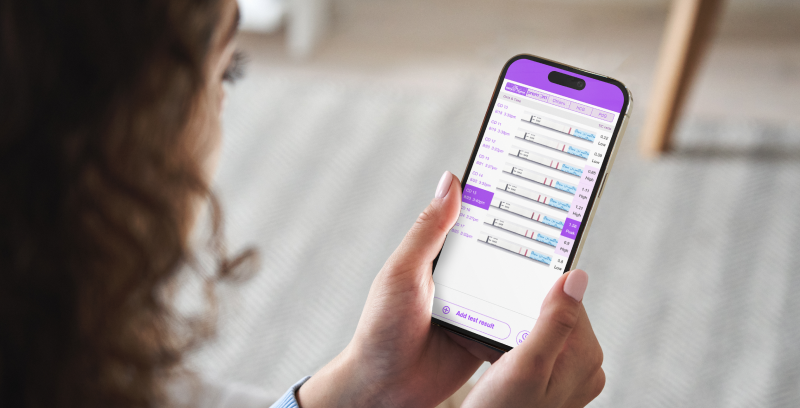
There’s a reason Premom’s sister brand, Easy@Home ovulation prediction test kits, are Amazon’s best sellers: they work. And they work fast. In fact, women who followed the Premom FastPass™ method achieved a pregnancy rate 202% higher than those who didn’t**. That’s if they use and upload them correctly in their Premom app — which is why our FastPass™ is driven by:
Compassionate support from seasoned fertility experts

After figuring out how to get pregnant fast to start their own families, then helping thousands of women do the same, mother of two, Dr. Patti Haebe, NMD and mother of three, Heather Frame BSN, RN have seen every imaginable cycle and Premom lifestyle.
That’s why their specialized, cycle-driven FastPass™ content includes various levels and formats of fertility education:
- Actionable video check-ins at each critical cycle phase
- In-app blog posts for detailed analysis
- Infographics for skimmable insights
- In-app videos on common FAQs and confusions
- Pop-ups and notifications to inspire and remind you to leverage all of the above
- ASK AI for those tricky questions that need some back-and-forth (Premoms who leverage it have shown higher pregnancy rates!)
And because our fertility specialists are constantly researching the critical differences between age demographics, they’ve developed targeted content on:
How to get pregnant fast if you’re 25-34 years old
Some of our younger Premoms assume they don’t need direction or inspiration, but Nurse Heather has observed what happens when they do come around and leverage it:
“When I was trying to get pregnant in my late 20s, I assumed it would be easy. But even as a nurse, I realized how little I truly knew about my own cycle. That’s why I’m so passionate about helping women now—once you actually understand how to get pregnant fast, and have the right tools, it can change everything,” says Frame.
How to get pregnant fast if you’re 35 or older
Premoms over the age of 35 can have different preconceptions that add unnecessary stress from social circles that mean well but know little.
“I remember what it was like trying to figure out how to get pregnant fast when we made the decision to have children,” says Dr. Heabe, “I wish I’d had this kind of coaching then — I’d have decreased the stress that prolonged my journey to motherhood.”
Cutting edge cycle-tracking tools

When you feed it the data it needs, Premom’s proprietary algorithm can predict your fertile window so you can time sex appropriately! Of course, the more information you upload every cycle, the more accurate your predictions become over time, until you know exactly what your body’s gonna do next.
It all starts with tracking your period to create your cycle charts in the Premom app. Tracking your basal body temperature is a breeze with our proprietary Auto-Scan feature, and so is uploading your hormonal test strip result, whether it’s for your:
- Luteinizing Hormone (LH) to find your ovulation day
- Progesterone hormone metabolite (PdG) to track your ovulation or,
- Human chorionic gonadotropin (hCG) hormone to discover you’re pregnant!
Once your data and our tech come together, you’ll get charts that show exactly what’s going on with your cycle so you can take the right actions at the right time.
The rarely redeemed money-back-guarantee
Although few Premoms need to take advantage of it, we do guarantee that if you don’t get pregnant after following the FastPass™ method for 6 months, we’ll gladly refund your investment in your fertility.
Decades of fertility care synergized with groundbreaking predictive analytics make the FastPass™ the most precise and personalized answer to that so often searched query: “How to get pregnant fast.” These time-tested strategies enabled Premom to help 1 million women fulfill their dreams of becoming mothers.*
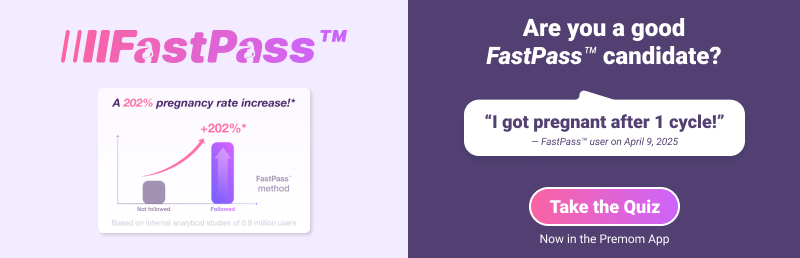
*Over 1 million users logged pregnancy or positive pregnancy test results while using the Premom App
**Based on internal analytical studies of 0.9 million users. For full details, please refer to FastPass terms available under our Terms of Service.
References:
Centers for Disease Control and Prevention. National Center for Health Statistics. Press Release: 2024 Updates on Health Statistics. May 25, 2024. Available at: https://www.cdc.gov/nchs/pressroom/nchs_press_releases/2024/20240525.htm. Accessed on May 19, 2025.
National Health Statistics Reports Number 202, April 24, 2024, Infertility and Impaired Fecundity in Women and Men in the United States, 2015–2019, Colleen N. Nugent, Ph.D., and Anjani Chandra, Ph.D.U.S. DEPARTMENT OF HEALTH AND HUMAN SERVICES Centers for Disease Control and Prevention. Available at: https://www.cdc.gov/nchs/data/nhsr/nhsr202.pdf
Practice Committee of the American Society for Reproductive Medicine. Definitions of infertility and recurrent pregnancy loss: A committee opinion. Fertil Steril 2020;113:533–5. Available at: https://pubmed.ncbi.nlm.nih.gov/23095139/


