
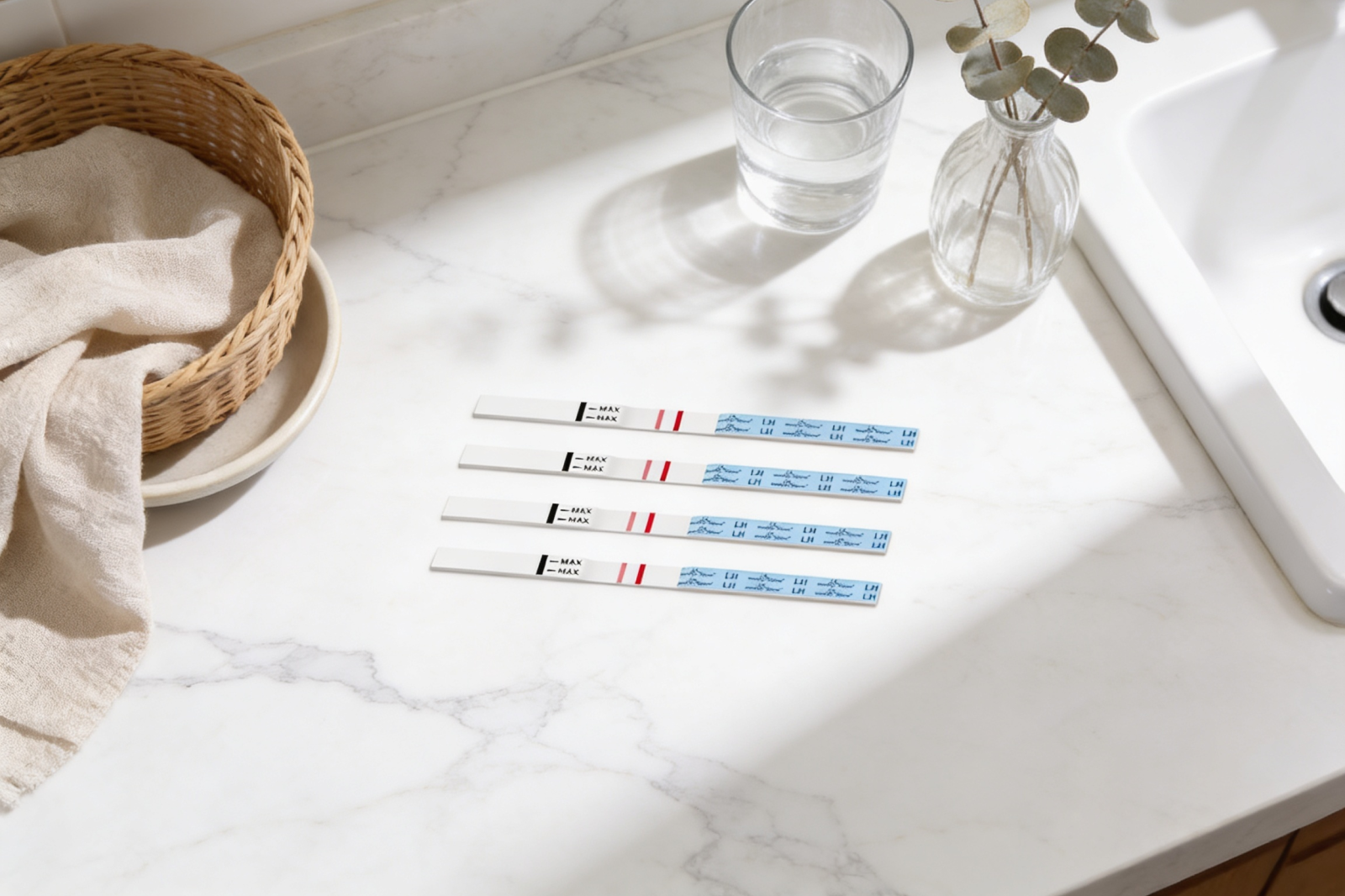
If you have PCOS and your ovulation test is always showing positive, there is a biological reason behind it. Epidemiological data shows PCOS affects approximately 8 to 13 percent of reproductive-aged women globally. Associated hormonal imbalances often cause chronically elevated LH (luteinizing hormone) levels. These levels sit above the threshold standard OPKs use to detect a surge. This means your test strips can appear positive on most days of your average cycle, even when no egg is about to be released. With PCOS, a persistently positive ovulation test may be a false positive, as the body produces elevated LH levels while attempting to ovulate, but an egg release may not actually occur. The natural way to spot a true ovulatory surge is to track your LH result over time alongside basal body temperature (BBT) to identify a true peak above your baseline.
Key Takeaways
- A persistently positive OPK with PCOS is frequently caused by chronically high baseline LH levels.
- Tracking LH as a numerical trend over several days may help distinguish your personal baseline from a true surge.
- Pairing LH testing with BBT tracking adds post-ovulation context that LH testing alone cannot provide.
Key Terms Explained
- Luteinizing Hormone (LH): The hormone that surges to trigger the ovaries to release an egg. A natural surge concentration ranges from 20 to 100 mIU/mL.
- Basal Body Temperature (BBT): Your body’s lowest resting temperature. Tracking your BBT may help identify if an LH surge actually resulted in ovulation.
- Anovulation: When the body attempts to ovulate but fails to release an egg.
- Quantitative LH Result: A numerical hormone value provided by cycle tracking apps like Premom, rather than a simple positive or negative result.
- hCG (Human Chorionic Gonadotropin): The pregnancy hormone. It shares a nearly identical biological structure with LH, causing routine cross-reactivity on test strips.

What Is the LH Surge and When Does It Happen?
Your LH surge occurs when luteinizing hormone levels rise abruptly in the bloodstream. Medical research from Frontiers in Public Health shows that a urinary LH surge concentration typically ranges from 20 to 100 mIU/mL. This hormone surge triggers the ovaries to release an egg. Clinical studies suggest ovulation typically occurs about 24 hours after this LH peak. Finding this specific peak may help you understand when ovulation may be approaching.
What Does a Real Positive Ovulation Test Look Like?
A real positive ovulation test shows a test line as dark as or darker than the control line. This pattern suggests your most fertile days are approaching. Important tip: Always read your test within 5 to 10 minutes.
Why PCOS Causes a Persistently Positive Ovulation Test
What Is Chronically Elevated LH in PCOS?
Many women with PCOS experience consistently high LH levels. A clinical study in the Journal of Clinical Endocrinology & Metabolism notes that women with PCOS often exhibit consistently elevated LH pulse frequency and amplitude. Since your baseline is already sitting elevated above typical thresholds (like 25 mIU/mL), a standard ovulation test strip might appear positive most of the time.
Will My Ovulation Test Always Come Back Positive if I Have PCOS?
Not always, but it is very common. Your body naturally produces more LH. This continuous hormone elevation causes your baseline to sit significantly above the average level.
Multiple LH Surges With PCOS: What They Mean
What Are Multiple LH Surges?
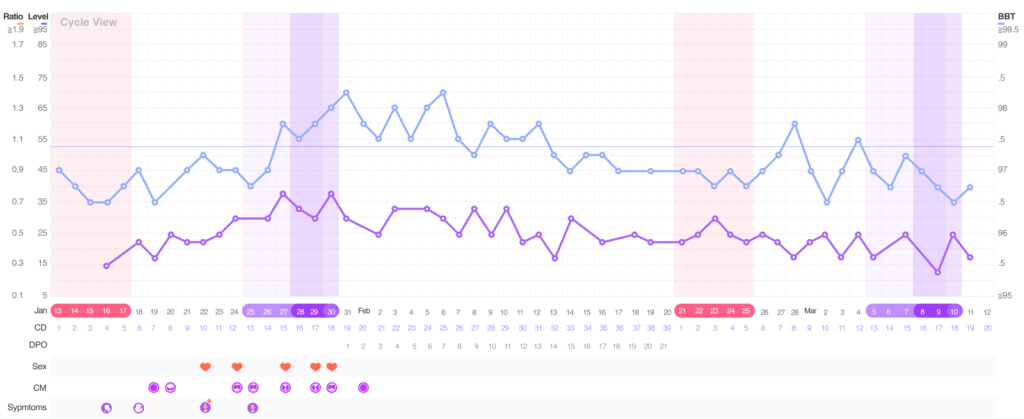
Multiple LH surges mean your body attempts to ovulate repeatedly within one cycle. You might notice several LH rises before an egg finally releases. A medical study highlighted that surges arrive in various configurations.

Double, Biphasic, and Gradual LH Surges: Which Is PCOS?
| Surge Type | What It Looks Like on OPK | Common in PCOS? | What It Means |
|---|---|---|---|
| Standard surge | Low baseline, then strong peak, then drop | Less common | True ovulation is likely |
| Double LH surge | Two rises in the same cycle | Moderately common | First rise may not lead to ovulation. A BBT rise following the second peak may suggest that ovulation has likely occurred. |
| Biphasic surge | Two distinct peaks, days apart | Common in PCOS | Possible delayed ovulation or anovulation |
| Multiple surges | Several LH rises across the cycle | Very common in PCOS | Often anovulatory, as no egg is released. Delayed ovulation is possible in some cycles. |
| Gradual or slow surge | Slow rise over many days | Common in PCOS | Hard to find peak; BBT tracking is essential |
Stop guessing what your OPK line means. Premom shows your LH curve over time, which may help you finally see the difference between your baseline and a real peak. Start tracking with the Premom app.
How to Tell if Your Positive Ovulation Test Is Real With PCOS
Tracking Your Personal LH Baseline: The Key to Understanding Your Results
Your LH baseline is your unique, day-to-day hormone level — not a one-size-fits-all number. By testing consistently across your cycle, you begin to understand your normal range and patterns. This helps you identify a true surge as a meaningful rise above your usual levels, rather than relying only on how dark a test line looks.
Over time, this approach gives you a more precise and personalized way to track ovulation, especially if your LH levels fluctuate or stay slightly elevated.
Combining OPK Testing With Basal Body Temperature (BBT) for PCOS
Pairing your daily LH tests with BBT tracking can reveal how your cycle is actually behaving over time. After ovulation, progesterone causes a small but measurable rise in resting temperature, typically around 0.5 to 1.0°F (0.2 to 0.5°C). A sustained rise held across several days following your LH peak may suggest ovulation has likely occurred, adding useful context that LH testing alone cannot provide. Internal data indicates that tracking with OPKs and BBT together provides a 231 percent increased accuracy in cycle predictions. Used together, easy@Home ovulation tests and the Premom app give you a more complete picture of your cycle, with your LH trend and BBT data building alongside each other over time.
Combining OPK With Cervical Mucus Changes in PCOS
Look for fertile cervical mucus — clear, stretchy, and slippery (like egg whites). When this type of mucus appears along with a positive OPK, it’s more likely to indicate a true ovulation window.
How Many Days Should You Test With PCOS?
Start testing with OPKs and tracking BBT right after your period ends. Continue testing daily (or twice a day) until you see a clear LH peak followed by a sustained rise in BBT. With PCOS, cycles can be longer and you may notice multiple positive LH tests that aren’t true ovulation peaks. Even if you see several surges, keep testing until you find a true LH peak that is followed by a BBT rise within about 48 to 72 hours, which may suggest ovulation has likely occurred.
Finding your true LH surge can be harder with Polycystic Ovary Syndrome, but tracking with OPKs, BBT, and cervical mucus together can give you better clarity.
If you want more guidance, Premom’s Ask AI feature gives you instant educational responses to cycle questions directly in the app. For a deeper conversation, virtual consultations are one-on-one appointments with a Premom provider to walk through your chart and tracking data directly.
You can also take a PCOS self-assessment on the Premom Ovulation Tracker app to better understand your cycle.
How Does Premom Help You Track Your PCOS?
Meet PCOS Pro: Built for Cycles That Don’t Follow a Predictable Pattern
Irregular cycles are harder to track with tools designed for typical 28-day cycles. PCOS Pro is a 6-month pass in Premom, built specifically for people with irregular cycles or PCOS.
It’s a one-time purchase, not a subscription. It doesn’t auto-renew. And it’s separate from Premom Premium, so you can use it with or without a membership.
How PCOS Pro Helps You
This pass may help you feel more in control of your body. Here is what you get:
- Tracking tools built for complex and irregular cycles.
- Daily health logs for your sleep, what you eat, and your stress levels.
- Cycle pattern insights that build over time as your data grows, so you can understand your body more clearly.
- Guides and educational tips from experts focused on PCOS and hormonal health.
Take the Next Step
Want to learn more about your body? Join PCOS Pro here. One-time purchase. No recurring fees.
Frequently Asked Questions
Many people managing PCOS have chronically high LH, resulting in highly frequent positive test reads. Due to this, you might see multiple LH surges throughout your cycle. However, with an app like Premom, you can track your quantitative LH levels. By pairing your OPK results with basal body temperature (BBT) tracking and cervical mucus signs, you might identify your true ovulatory peak.
PCOS primarily influences ovulation frequency and hormonal balance, but it does not rigidly define your egg quality. While irregular cycles can make it harder to predict when you release an egg, your age is generally considered a more significant factor in egg quality. By tracking your cycle trends over time, you can support your chances of conception by understanding when your fertile window may be occurring.
Not always, as PCOS is a diverse condition with varying symptoms. However, chronically elevated LH is a common and manageable finding for countless women managing PCOS. Understanding your personal hormonal baseline tends to be more useful than comparing your results to a generic standard threshold.
Yes, the test strips measure the presence of luteinizing hormone in your urine. However, standard visual interpretations often fail. Tracking quantitative numeric levels through an app like Premom gives you a clearer picture of your hormone trend, allowing you to spot a relatively higher surge above your personal baseline, especially when combining these tests with BBT.
Yes. The pregnancy hormone (hCG) is structurally almost identical to luteinizing hormone (LH). This biological cross-reactivity frequently causes an ovulation test strip to display a clearly positive dark line during early pregnancy. Since PCOS already naturally elevates your baseline LH, it is especially important to follow up on a suspected pregnancy with a dedicated pregnancy test rather than relying on OPK patterns.
They often display dark, highly positive test lines for multiple days consecutively without an easily discernible single peak line. You might also notice irregular or biphasic patterns, where the line darkens, lightens, and darkens again over a few days. Using a tracking tool like Premom, which maps your test line as a number over time, gives you a clearer picture than reading lines visually.
Disclaimer: This article is for educational purposes only and is not intended to diagnose, treat, cure, or prevent any medical condition. Always consult a qualified healthcare provider for personalised medical advice regarding menstrual health, fertility, or hormonal concerns.
References
- World Health Organization. Polycystic ovary syndrome. Published June 28, 2023. Accessed April 13, 2026. https://www.who.int/news-room/fact-sheets/detail/polycystic-ovary-syndrome
- Leiva RA, Bouchard TP, Abdullah SH, Ecochard R. Urinary Luteinizing Hormone Tests: Which Concentration Threshold Best Predicts Ovulation? Front Public Health. 2017;5:320. Published 2017 Nov 28. doi:10.3389/fpubh.2017.00320. https://www.ncbi.nlm.nih.gov/pmc/articles/PMC5712536/
- Su HW, Yi YC, Wei TY, Chang TC, Cheng CM. Detection of ovulation, a review of currently available methods. Bioeng Transl Med. 2017;2(3):238-246. Published 2017 May 16. doi:10.1002/btm2.10058. https://www.ncbi.nlm.nih.gov/pmc/articles/PMC5689497/