
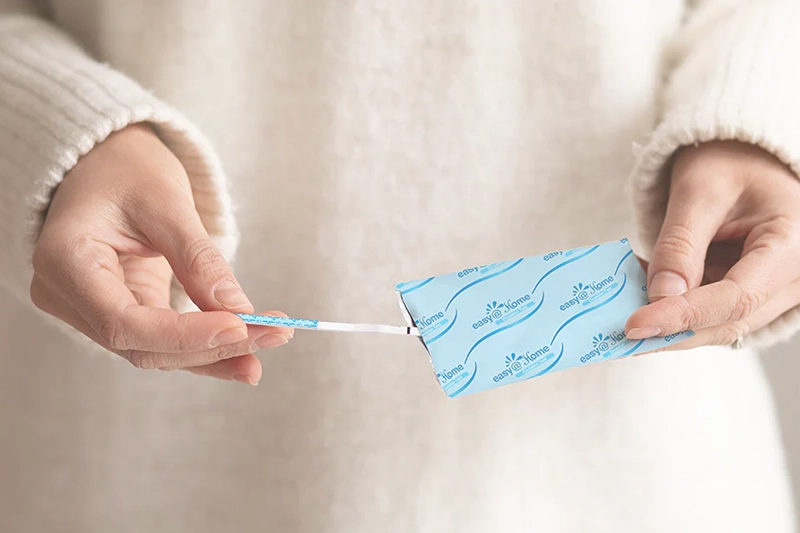
If you are trying to conceive, you are probably very familiar with the fertile window and how chances of conception increase as you approach ovulation day. LH (Luteinizing Hormone) tests, also known as ovulation tests or OPKs, are a vital tool for trying to get pregnant. They can help identify your most fertile days of the cycle with accuracy to time intercourse accordingly and increase your chances of conception.
LH Surge v. LH Peak: What are they?
LH is the hormone in the body that surges once per month and is responsible for triggering ovulation aka the release of an egg. The LH surge signals the beginning of the rise in LH or opening of your fertile window, which can last anywhere from a few hours to a few days and is detected by using ovulation tests. The LH peak occurs on only one day of each cycle. Your peak is the last, highest result of luteinizing hormone during your cycle.

How long after an LH surge do you ovulate?
Ovulation is a science so there is no cut-and-dry answer on when ovulation will occur after a surge or peak, but rather a range of possibilities. As ovulation approaches, the ovaries release estrogen which sends a message to the brain to release that surge of luteinizing hormone. The highest level of luteinizing hormone, also called an LH peak, is what triggers ovulation to occur within the following 24 hours.

Looking at the chart above you can see an LH surge on CD 25, with ovulation happening on CD 26 that was confirmed by a rise in BBT on CD 27.
How can I find my LH surge?
By using ovulation tests, you can catch the timing that LH levels begin to rise and also identify when they reach a peak level. You will want to start using LH testing kits the day after your period ends until you have confirmed ovulation, or 2-3 days after your detected peak.
You can test once per day between the hours of 10 am-8 pm after your period ends, and increase your testing to twice per day during your predicted fertile window to ensure you don’t miss that peak. It is recommended to continue LH tracking for 2-3 days after your LH peak to ensure you have truly identified your peak. You may also stop tracking when your BBT (basal body temperature) reading spikes confirming ovulation occurred, whichever method of tracking suits your needs.
If you have not found your LH surge, or are having low LH levels, keep testing! It is possible that ovulation just hasn’t happened yet which does not mean that you are having an anovulatory cycle. The follicular phase of the cycle can vary, meaning ovulation can fluctuate a little from month to month, so if ovulation is a little delayed this cycle, don’t give up just yet!
Does an LH surge always mean ovulation?
An LH surge is often associated with the onset of ovulation, making it a useful tool for predicting fertile days. Ovulation predictor kits (OPKs) detect the surge in LH levels in urine, indicating that ovulation is likely to happen within the next 24 hours.
However, it’s important to understand that an LH surge does not always indicate ovulation. In some cases, known as anovulatory cycles, ovulation does not occur despite the presence of an LH surge. Several factors can disrupt ovulation, including stress, hormonal imbalances, certain medical conditions, or the use of specific medications. Therefore, while an LH surge provides a helpful indication of impending ovulation, it does not always guarantee its actual occurrence. You will need other methods to confirm ovulation.
Factors that can affect LH surge and ovulation
While an LH surge is generally a positive sign of imminent ovulation, several factors can affect its reliability:
- Irregular menstrual cycles: Women with irregular menstrual cycles may experience inconsistent LH surges or have difficulty detecting them, making ovulation prediction more challenging.
- Anovulatory cycles: An anovulatory cycle occurs when ovulation doesn’t take place. It’s possible to have a mild LH surge but not release an egg, leading to an anovulatory cycle. Various factors, including stress, hormonal imbalances, or certain medical conditions, can disrupt the normal ovulation process.
- Rapid surge and short duration: In some cases, the LH surge may occur suddenly and last only for a short duration, making it challenging to accurately detect and time intercourse for conception.
- False negative results: Ovulation predictor kits are highly sensitive but may on occasion still produce false-negative results. External factors like diluted urine, improper kit usage, or certain medications can affect the accuracy of the results.
Understanding these factors and their potential impact on the LH surge can provide valuable insights for individuals trying to conceive or track their ovulation.
When should I have sex around my LH surge?
Since the fertile window is 6 days long including ovulation day, you want to start timing sex a few days before you ovulate to ensure the sperm are waiting in the fallopian tubes ready for that perfect egg to be released.
Because there is a range of when ovulation can happen after the start of an LH surge and the sperm can survive up to 5 days, it’s important to have sex the days leading up to ovulation, on your LH surge, and the following 1-2 days. The Premom app is a great tool to help you visualize and easily plan out what days to have sex to best increase your pregnancy chances.
Importance of accurate ovulation tracking
Accurate ovulation tracking holds significant importance for various reasons, including fertility optimization, cycle tracking, and pregnancy avoidance. Whether you are trying to conceive, gain a better understanding of your body, or avoid pregnancy, having precise knowledge of ovulation is essential. Premom makes knowing when and if you ovulate that much easier!
- Simply start by logging ovulation tests in the app beginning the day your period ends. The Premom app can automatically read your test strips and analyze the results to provide you with an accurate prediction of when you will ovulate.
- As you continue to log ovulation tests, Premom will identify your LH surge and provide you with your predicted ovulation date. Get helpful tips and suggestions on timing intercourse for conception, hormonal patterns, and general well-being.
- Finally, use the app to track your cycles and monitor your fertility so you can stay on top of your reproductive health and achieve your fertility goals.
Download the free Premom app today and see the difference it can make in your fertility journey.
References
- PubMed. National Center for Biotechnology Information. https://pubmed.ncbi.nlm.nih.gov/.
- J; K. Ovulation detection in the human. Clinical reproduction and fertility. https://pubmed.ncbi.nlm.nih.gov/6821195/
- American Pregnancy Association. (2021, January 22). Ovulation kits and fertility monitors. Retrieved April 30, 2023, from https://americanpregnancy.org/getting-pregnant/ovulation-kits/
- Fertility Authority. (n.d.). How to maximize your chances of getting pregnant during the LH surge. Retrieved April 30, 2023, from https://www.fertilityauthority.com/ovulation/how-maximize-your-chances-getting-pregnant-during-lh-surge
- Mayo Clinic. (2021, March 25). Home ovulation kits: Can they help you conceive? Retrieved April 30, 2023, from https://www.mayoclinic.org/healthy-lifestyle/getting-pregnant/expert-answers/home-ovulation-kits/faq-20058112Women’s Health Concern. (2021, April). Ovulation and the menstrual cycle fact sheet. Retrieved April 30, 2023, from https://www.womenshealthconcern.org.uk/conditions-and-treatments/ovulation-and-the-menstrual-cycle-fact-sheet/


