
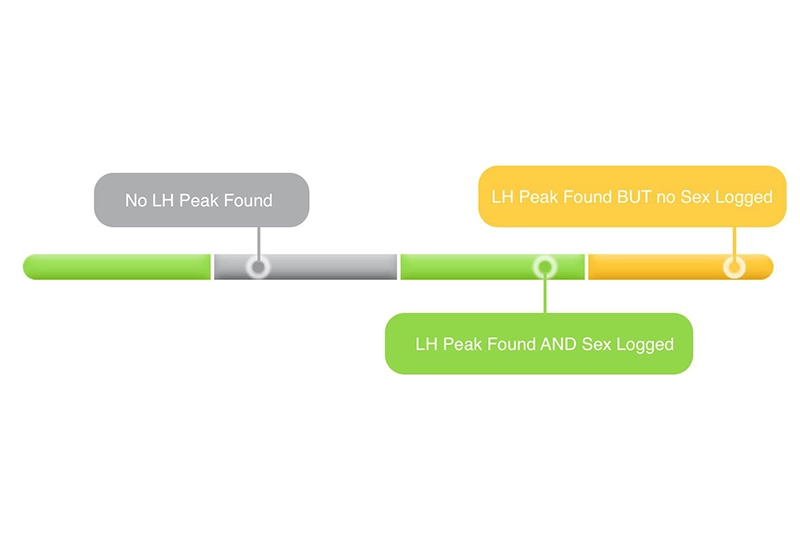
Did you know that when you track your data in Premom, each cycle is assigned a pregnancy progress tracker? See your progress bar by joining our free Money-Back Guarantee Program right in the Premom app.
Gray — Your Premom cycle status will be “gray” until a peak fertility day is found. If peak fertility is not found, it will remain gray.
Yellow — If your Premom cycle status is labeled “yellow,” it indicates that your peak has been found (things are looking good), but you did not log sex on the most fertile days (the ovulation day and two days prior to ovulation) in that cycle.
Green — Your Premom cycle Status will be assigned “green” if you’ve had a recognized LH (luteinizing hormone) peak or basal body temperature (BBT) spike and logged intercourse during your most fertile days (ovulation day and the two days prior to ovulation).
You can utilize this pregnancy tracker to monitor the fertile quality of your cycles.

Gray Cycles
Is your peak fertility day missing? Your cycles will remain gray in the pregnancy progress tracker until a peak fertility day is recognized. You may be wondering where your peak fertility days are if you’ve been using ovulation tests.
Some women will consistently be at a low baseline for LH, the hormone responsible for triggering ovulation. Others will have various small LH surges but no significant peak. If this sounds like you, it’s a good time to look into why your LH is not surging properly.
LH is a hormone that is released from the brain. When it is not present, it is not likely that you are ovulating. Those that have irregular cycles may also see a delayed or strange pattern of LH surges.
One of the easiest first steps in investigating is to begin using ovulation tests two times a day for an entire cycle to ensure that you do not have a “Rapid LH Surge” and are perhaps missing your fertility window. It’s an easy way to ensure that you aren’t missing something as simple as a short ovulation window!
This is a great time to begin a conversation with your doctor about why you are not ovulating; you can even share your data with them through the Premom Provider app at your next appointment! Often, your doctor needs to help investigate the cause of this absent ovulation. They’ll likely want to run some of the lab tests below:
- FSH (follicle stimulating hormone) – This hormone is present before LH surges and helps to stimulate the growth of follicles in your ovaries. If the ovaries are not responding to FSH, such as in PCOS, the FSH levels will be elevated.
- Prolactin– Prolactin is another hormone in your brain that is also responsible for lactation in new mothers. When prolactin is elevated, it suppresses ovulation. If your prolactin levels are elevated, it could be from mismanaged stress — or rarely — something like a pituitary tumor.
- Progesterone– Although you should be able to see your BBT increase with the presence of progesterone, your doctor may also order a blood draw for progesterone. If it is below 3-5 ng/mL around day 21 of your cycle (based on a 28-day cycle), it is likely, that you are not ovulating.
- AMH (Anti-Mullerian Hormone) – This hormone is a good indicator of ovarian age and function. It helps to regulate follicle creation and is secreted by your ovaries. When this hormone is low, it’s an indicator that your ovaries aren’t making as many follicles as they used to, and it may be a good time for you to start considering reproductive interventions sooner rather than later.
It’s also important to look at the troubleshooting tips for green cycles to make sure you have received a thorough workup. You are always your own best advocate!

Yellow Cycles
You’ve found your LH peak, now what?
Fantastic news! If your LH peak has been detected by ovulation tests, it’s likely that you will ovulate this cycle, but it’s essential that you have timed your intercourse properly. Because sperm can live for up to 5 days inside the female reproductive tract — but eggs only live for about 24 hours — it is essential that intercourse takes place both before and on ovulation day. Use your Premom chart as a reference for proper intercourse timing before your estimated ovulation date arrives!
After your LH has surged, it’s imperative to continue taking your basal body temperature at the same time each day to confirm your ovulation. If your BBT increases after your LH peak, it is a good indication that you have ovulated. The residual corpus luteum is producing progesterone, which raises your basal body temperature.
Keep tracking your BBT, LH levels and cervical mucus quality daily to optimize your chances for fertility!

Consistently Having “Green” Cycles But Not Getting Pregnant?
It’s time to dig deep! If your cycles are classified as “green” in our pregnancy tracker, it means that your cycles are looking good. There is significant reason to believe ovulation is taking place — so what is missing?
For those younger than 35 years old, there is a 25-30% chance of getting pregnant each cycle — even when everything is looking good. If over the age of 35, there is an 8-15% chance of conception per cycle, and it’s 2-5% per cycle if between the ages of 40-43. So, what can we learn from this? It’s important to keep trying: keep consistent with tracking ovulation tests each month so you do not miss your LH surge, and continue to monitor cervical mucus and basal body temperature to confirm that you truly are ovulating each cycle.
Time to Investigate
It may also be time to take the next steps to investigate other obstacles that may be preventing you from conceiving.
Has your partner had a semen analysis?
Perhaps this would be a good time if they have not been tested in the past 2 years. It’s important to rule out male factor infertility, which makes up for almost 40% of all infertility cases!
Have your anatomy checked out!
If you are getting a great LH peak and clear BBT rises, perhaps it’s time to make sure there are no anatomical anomalies that could be preventing ovulation and implantation.
There are a few ways to investigate. Lower abdominal and vaginal ultrasounds can help to identify any strange ovarian appearance and may show any adhesions, polyps, or fibroids that could be affecting endometrial tissue, thus affecting implantation. In addition, many OB/GYNs can identify the position of your uterus through a simple physical examination.
Hysterosalpingograms are another way to identify any blocked fallopian tubes that may be preventing eggs from making the journey from the ovaries into the uterus.
Do You Have “Green” Cycles…. But Short Ones?
Perhaps all the above looks good; you are ovulating well, but your luteal phase (the second half of your cycle) is less than 10 days, indicating something called luteal phase deficiency/defect.
This can be problematic when trying to conceive, as the inflammatory cascade that initiates your period triggers a couple of days before your period begins. If your luteal phase is only 10 days long, there isn’t enough time for a fertilized egg to properly implant before the menstrual cascade begins. If this sounds like you, consider speaking with your doctor to check your progesterone levels or discuss some fertility medication options with them. Integrative physicians often recommend herbs such as Vitex or seed cycling, in hopes of lengthening your cycles. Either way, it’s best to work with an expert to ensure you are on the right track! Check out our Premom fertility specialists for a virtual consultation!
References