
Are you trying to conceive and looking for a reliable way to understand your cycles and identify your most fertile days? Welcome to Premom, designed to help women like you track their cycles, understand their fertility patterns, and get pregnant faster.
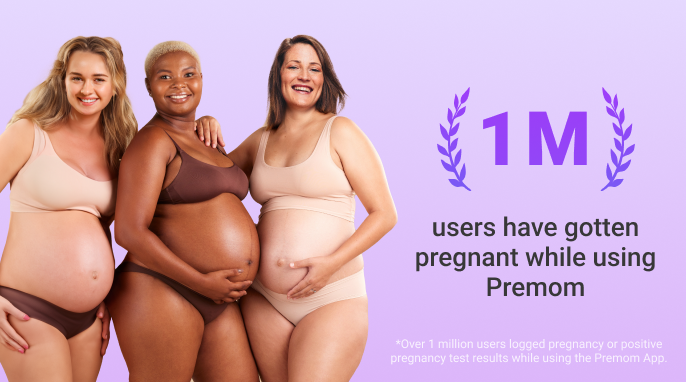
Whether you are new to cycle tracking or have been trying for a while, you’re in the right place! Over 1 million women have gotten pregnant while using the Premom app and we’re thrilled to help you along your journey, too1.
Understanding Your Fertile Window
To get pregnant, finding your fertile window is a must. Your fertile window is the only time during your cycle when you can get pregnant and consists of the 5 days leading up to ovulation and ovulation day.
Having sex outside of your fertile window cannot result in pregnancy. In order to find this narrow 6-day window to time sex appropriately for conception, you’ll need to consistently track ovulation.

How to Track Ovulation When Trying to Conceive
Understanding and tracking your ovulation will help you increase your chances of conception. Here are two of the most effective methods:
Ovulation Predictor Kits (OPKs)
Ovulation predictor kits, more commonly known as ovulation tests, are highly effective tools that detect a surge in luteinizing hormone (LH), which occurs within 24 hours before ovulation. This LH surge is a reliable indicator that your body is about to release an egg, marking your most fertile days. By using these kits, you can identify your fertile window with precision, ensuring that you time intercourse for the highest likelihood of conception.
Basal Body Temperature (BBT) Tracking
Basal body temperature tracking involves measuring your temperature each morning before getting out of bed. A slight increase in BBT, typically about 0.5 to 1ºF, indicates that ovulation has occurred. By charting these temperature changes over time, you can identify patterns in your cycle and predict future ovulation. While BBT tracking requires daily consistency, it offers valuable insights into your menstrual cycle and helps confirm that ovulation has taken place.
How to Identify Your Most Fertile Days
If your cycle isn’t a perfect 28 days (and let’s be honest, most of us aren’t that predictable), tracking your period alone might not give you the full picture of your fertility. That’s where the Premom app comes in.
Our app combines reproductive hormone data with smart AI algorithms to give you a personalized fertility forecast. It’s like having a fertility expert in your pocket! We use a simple color-coded system to show you exactly where you are in your cycle and what steps you can take to boost your chances of conception.
Premom’s Cycle Statuses Explained
The Premom App provides a Cycle Status using a four-color system to indicate how optimal your chances of pregnancy are each day throughout your cycle. This status is based on the core data you log, such as ovulation tests or basal body temperature logs, which the app will help you analyze to identify when your ‘peak’ fertility days are.
White Cycle: You are only logging your period. To get more accurate predictions, start tracking your ovulation with ovulation predictor kits (OPKs) or basal body temperature (BBT).
Gray Cycle: You are logging OPKs or BBT, but no LH peak or BBT spike has been found. Keep tracking consistently; it may take a few cycles for patterns to emerge.
Yellow Cycle: An LH peak or BBT spike has been found, but sex did not occur on at least one peak fertility day or ovulation day. Try to have sex on these three days in your next cycle.
Green Cycle: This is your optimal cycle status outcome for increased pregnancy chances! You have found an LH peak or BBT spike and had sex on at least one peak fertility day or ovulation day.
You can see your Cycle Status anytime on your app’s home screen. This color-coded system gives you a clear, personalized view of where you are in your cycle and what steps you can take to boost your chances of conception.
One Key to Help with Pregnancy Success: Premom Green Cycles
Achieving Green Cycles is the key to increasing your chances of getting pregnant within the Premom app.
Achieving Green Cycles within the Premom app will give you your best chance at a natural conception. Here’s how simple it can be to get a Green Cycle status:
- Upload ovulation tests or basal body temperature temps to your Premom app
- Keep testing until Premom identifies your LH peak or BBT spike
- Have and log intercourse on any of the days when Premom shows ‘Peak Fertility’ or ‘Ovulation Day’ right on the top of your app’s homepage.
Follow all three steps and you are on your way to success!
Stay Consistent for Optimal Results
Consistency matters when it comes to cycle tracking. It may take a few cycles for Premom to learn your patterns and provide the most accurate ovulation predictions. By regularly logging ovulation tests or BBT data, you’re already taking proactive steps toward providing yourself with the most accurate data possible.
Consistency in tracking your cycle is essential for maximizing your chances of conception. Start by logging your ovulation tests or BBT data daily to gather accurate insights into your fertility.
Ready to get pregnant fast – purchase your first ovulation tests or upload your tests now to begin tracking with confidence and achieve your pregnancy goals!

References
- Over 1 million users logged pregnancy or positive pregnancy test results while using the Premom App.
- Holesh JE, Bass AN, Lord M. Physiology, Ovulation. [Updated 2023 May 1]. In: StatPearls [Internet]. Treasure Island (FL): StatPearls Publishing; 2024 Jan-. Available from: https://www.ncbi.nlm.nih.gov/books/NBK441996/
- Reed BG, Carr BR. The Normal Menstrual Cycle and the Control of Ovulation. [Updated 2018 Aug 5]. In: Feingold KR, Anawalt B, Blackman MR, et al., editors. Endotext [Internet]. South Dartmouth (MA): MDText.com, Inc.; 2000-. Available from: https://www.ncbi.nlm.nih.gov/books/NBK279054/
- Steward K, Raja A. Physiology, Ovulation And Basal Body Temperature. [Updated 2023 Jul 17]. In: StatPearls [Internet]. Treasure Island (FL): StatPearls Publishing; 2024 Jan-. Available from: https://www.ncbi.nlm.nih.gov/books/NBK546686/#