
PCOS (Polycystic Ovary Syndrome) has been officially renamed PMOS (Polyendocrine Metabolic Ovarian Syndrome) following a 14-year global research initiative published in The Lancet (May 2026). The condition itself has not changed; only the name has. Ovulatory dysfunction remains one of the most clinically relevant features of PMOS, particularly for fertility and cycle health.
Key takeaways
- PMOS is the same condition as PCOS; the name changed, not the diagnosis.
- Research states the old name was causing missed diagnoses and an overfocus on the ovaries, when the condition is really a broader hormonal and metabolic disorder.
- Anovulation remains the most important clinical factor; it’s what brings most women to care and what deserves the most focus.
- Lifestyle factors such as sleep, stress management, nutrition, and weight changes can meaningfully influence ovulatory function and metabolic health.
- Because PMOS involves multiple hormonal and metabolic systems, treatment plans can sometimes become overly complex. Many clinicians emphasize focusing first on evidence-based interventions that support ovulatory function and long-term metabolic health.
- Tracking your cycle with OPK, BBT, and cervical mucus gives you real, actionable data. Premom can help you make sense of it.
What Is PMOS? And Is It Different From PCOS?
PMOS, which stands for Polyendocrine Metabolic Ovarian Syndrome, is not a new condition. It is the same condition you may have known as PCOS, with a name that more accurately reflects what is actually happening in the body.
| Begriff/Bestandteil | Was es bedeutet |
|---|---|
| Polyendokrin | Betrifft mehrere Hormone, darunter Insulin, Androgene, LH und FSH |
| Metabolisch | Beeinflusst Insulinsensitivität, Glukoseregulation und Gewicht |
| Ovariell | Betrifft die Eierstöcke, einschließlich Follikelentwicklung und Eisprung |
| Syndrom | Eine Gruppe zusammenhängender Symptome |
The condition affects more than 170 million women worldwide — more than one in eight — making it one of the most common hormonal disorders among women of reproductive age (Teede HJ et al., The Lancet, 2026). If you have already been diagnosed with PCOS, your diagnosis is still valid.
Why Was the Name Changed From PCOS to PMOS?
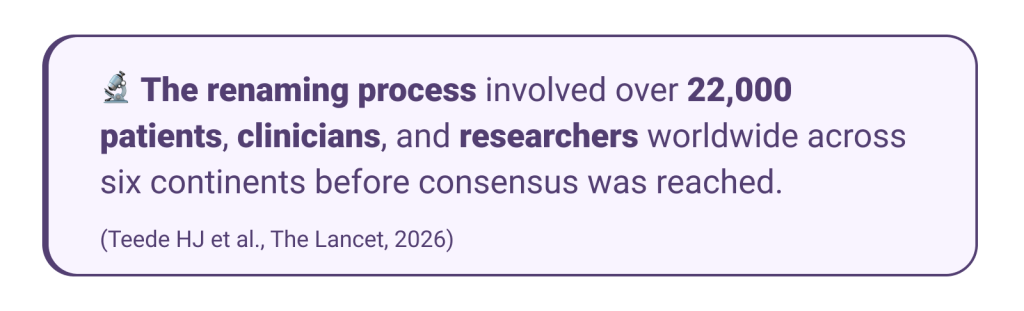
The rename followed more than 14 years of coordinated international research across six continents, led by Professor Helena Teede at Monash University in Melbourne, Australia.
A major concern with the original name was that it oversimplified and, in some ways, inaccurately represented the condition. The “cysts” sometimes seen on ultrasound are not true pathological ovarian cysts in the traditional clinical sense, but rather immature or arrested follicles associated with disrupted ovulation.
Researchers argued that the term “polycystic” has contributed to decades of misunderstanding around the condition, placing too much emphasis on ovarian appearance while overlooking the broader hormonal, metabolic, and endocrine dysfunction that often drives the syndrome.
The name PCOS also created an overfocus on the ovaries, when the condition is driven by a broader hormonal disruption involving insulin, androgens, and the hypothalamic-pituitary axis. This contributed to:
- Delayed or missed diagnoses
- Fragmented care across specialties
- Patients are not being screened for metabolic comorbidities
- Inadequate understanding of long-term health implications
The new name was chosen to be scientifically accurate, culturally appropriate across diverse populations, and easier to communicate for both clinicians and patients.
PCOS vs. PMOS: What’s the Difference?
There is no clinical difference between PCOS and PMOS. The table below summarises what changed and what stayed the same:
| Merkmal | PCOS (frühere Bezeichnung) | PMOS (neue Bezeichnung) |
|---|---|---|
| Name | Polyzystisches Ovarialsyndrom | Polyendokrines metabolisches Ovarialsyndrom |
| Diagnosekriterien | Rotterdam 2003 (2 von 3 Merkmalen) | Gleich – Rotterdam 2003 (2 von 3 Merkmalen), unverändert |
| Symptome | Unregelmäßige Zyklen, Anovulation, Androgenüberschuss, Insulinresistenz | Unregelmäßige Zyklen, Anovulation, Androgenüberschuss, Insulinresistenz |
| Behandlung | Lebensstiländerungen, Medikamente, gezielte Nahrungsergänzung | Lebensstiländerungen, Medikamente, gezielte Nahrungsergänzung |
| Auswirkung auf die Fruchtbarkeit | Anovulatorische Infertilität | Anovulatorische Infertilität |
| Was sich 2026 geändert hat | Der Name, um die breitere hormonelle und metabolische Realität widerzuspiegeln | — |
| Globale Prävalenz | Betrifft 1 von 8 Frauen im reproduktionsfähigen Alter | Betrifft 1 von 8 Frauen im reproduktionsfähigen Alter |
Should You Be Worried About the New Name?
The name change can understandably feel confusing or concerning at first, but the condition itself has not changed.
Words like «polyendocrine» and «metabolic» may feel heavier than «polycystic.» And if you were already confused about the difference between PCOS and PCOD, which many women are, adding PMOS into the picture can feel overwhelming.
It’s completely understandable to feel that way. Many women have shared the same reaction.
The important thing to understand is that the science and diagnostic criteria remain the same. The updated terminology reflects a broader understanding of the condition’s hormonal and metabolic features.
The three-year transition period (2026–2028) is designed specifically to support patients and clinicians through the shift, with a full guideline update expected in 2028.
What Are the Symptoms of PMOS?
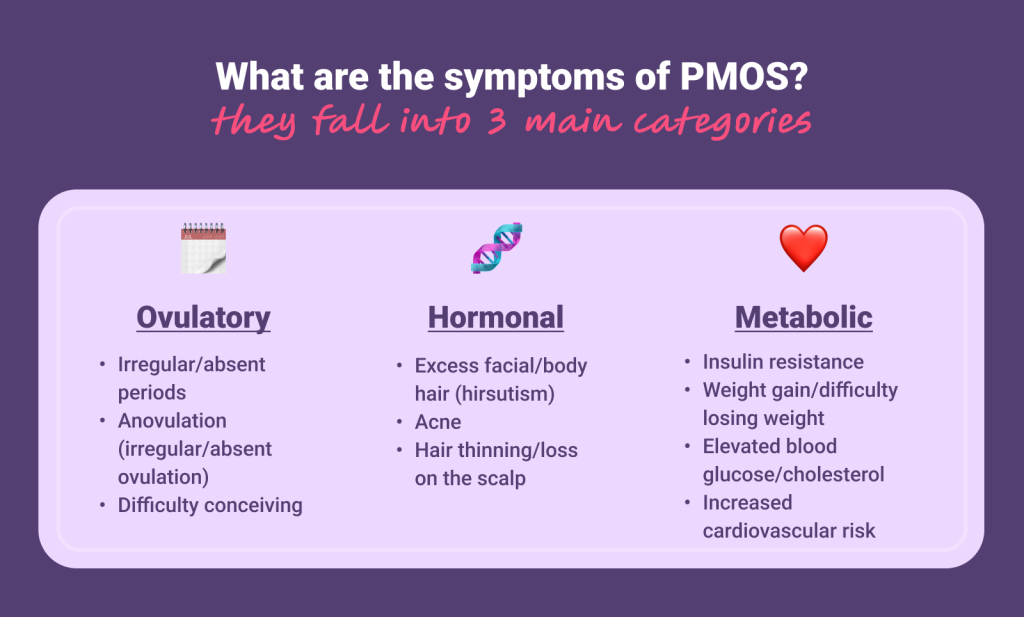
PMOS symptoms are identical to those previously associated with PCOS. They fall into three main categories:
Ovulatory Symptoms
- Irregular or absent periods
- Anovulation (irregular or absent ovulation)
- Difficulty conceiving
Hormonal and Androgenic Symptoms
- Excess facial or body hair (hirsutism)
- Acne
- Hair thinning or loss on the scalp
Metabolic Symptoms
- Insulin resistance
- Weight gain or difficulty losing weight
- Elevated blood glucose or cholesterol
- Increased cardiovascular risk
PMOS Insulin Resistance: The Metabolic Symptoms Explained
Insulin resistance is present in up to 70% of women with PMOS, regardless of body weight. When cells don’t respond effectively to insulin, the body produces more insulin, and elevated insulin stimulates the ovaries to produce excess androgens, which disrupts ovulation. This is why metabolic management is an important part of PMOS care, not just reproductive support.
What Is the Most Important Factor in PMOS?
Although PMOS involves metabolic, hormonal, and reproductive changes, ovulatory dysfunction remains one of the most clinically actionable features, particularly for individuals trying to conceive.
Many women first seek care because of irregular cycles, unpredictable ovulation, or difficulty conceiving. Disrupted ovulation patterns are one of the most common reasons patients pursue evaluation and treatment. Anovulatory infertility continues to be one of the leading fertility-related concerns associated with PMOS.
Because ovulation directly affects menstrual regularity and fertile window timing, identifying whether ovulation is occurring remains an important part of managing the condition.
The Risk of Shifting Focus Away From Anovulation
Here is where clinicians and patients alike need to pay careful attention.
The broader, more medically comprehensive framing of PMOS is scientifically justified. Metabolic health, insulin sensitivity, androgen levels – these are all real, important parts of the condition that deserve clinical attention.
But there is a real risk that comes with a name that sounds more complex and more systemic: it can shift focus away from anovulation – the core issue – toward a cascade of supplementation, medication, and expensive interventions that may not be the most appropriate first step for every patient.
Women who receive an expanded diagnosis framed around metabolic syndrome may feel that they are carrying a more medically complex condition than they thought. That can sometimes result in:
- Accepting aggressive treatment protocols that are not evidence-based for their specific presentation
- Taking multiplesupplements a day, many of which are not well-studied for PMOS specifically
- Spending significantly on treatments that address secondary features while the central issue – ovulation – goes under-managed
- Increased anxiety that itself worsens hormonal balance
This is not a hypothetical concern. Clinicians with long experience treating PCOS – now PMOS – have seen it happen. The label changes the way women understand their bodies, and that understanding shapes the decisions they make.
What Are the PMOS Diagnostic Criteria?
The diagnostic criteria for PMOS are the same as those previously used for PCOS. The Rotterdam criteria (2003) require at least two of the following three features: oligo-ovulation or anovulation, hyperandrogenism (clinical or biological), and polycystic ovaries on ultrasound.
- Oligo-ovulation or anovulation — irregular or absent ovulation, typically fewer than 8 cycles per year
- Hyperandrogenism — elevated androgens confirmed by blood test, or clinical signs such as excess hair growth (hirsutism) or acne
- Polycystic ovarian morphology on ultrasound — 20 or more follicles per ovary, or ovarian volume greater than 10 mL
Anovulation, meaning irregular or absent ovulation, remains the most important clinical feature. If you were previously diagnosed with PCOS, your diagnosis is still valid under the new name. No re-diagnosis is required.
How Is PMOS Diagnosed?
PMOS is diagnosed using the same Rotterdam criteria used for PCOS. A diagnosis requires at least 2 of the 3 features listed above. Your doctor may use a combination of:
- Blood tests: LH, FSH, total and free testosterone, DHEAS, fasting insulin, and fasting glucose
- Pelvic ultrasound: to assess follicle count and ovarian volume
- Cycle history: tracking menstrual regularity over 3 or more months
What Approaches Commonly Support Ovulatory Health in PMOS?
For the majority of women with PMOS, the most effective interventions are not the most expensive ones. Clinicians who have treated this condition for years consistently find that the following have measurable, meaningful impact on ovulatory function and overall outcomes:
- Weight management: Even modest reductions in body weight (5–10%) can restore ovulation in women with PMOS-related anovulation.
- Sleep quality: Poor sleep disrupts cortisol and insulin regulation, both of which affect ovulatory cycles.
- Stress reduction: Chronic stress elevates cortisol, which suppresses reproductive hormones.
- Targeted, evidence-based supplementation: Not a blanket protocol of multiple supplements, but specific support for ovulatory and metabolic health where indicated.
The goal is not to treat a label. The goal is to restore or support ovulation, regulate the cycle, and — for women who are trying to conceive — identify and time the fertile window.
Whatever you call the condition, PCOS, PCOD, or PMOS, that goal remains the same.
How Premom Can Support You With PMOS
Understanding your cycle is one of the most empowering things you can do when managing PMOS, and that’s where Premom can help.
Because anovulation is central to PMOS, tracking ovulation is the most practical, accessible tool available. Premom gives you real data, not guesswork.
With Premom, you can:
- Track OPK (ovulation predictor kit) results – Premom reads easy@Home OPK strips, converts test line intensity into numerical T/C ratio values, and charts LH progression across multiple days rather than showing only a simple positive or negative result. This can be helpful for individuals with PMOS, who may experience irregular LH surges or multiple peaks. Research shows LH surge patterns can be spiking, biphasic, or plateau, and that gradual-onset surges occur in over 57% of cycles.
- Track BBT (basal body temperature) – BBT tracking can help you understand whether ovulation actually occurred.
- Track PdG (pregnanediol glucuronide) patterns – PdG testing measures a urine metabolite of progesterone after ovulation. When used alongside LH and BBT tracking, PdG patterns can provide additional insight into luteal phase health and ovulatory patterns.
- Monitor cervical mucus changes – alongside OPK and BBT, cervical mucus is a key fertility sign that Premom helps you log and interpret.
- Identify cycle patterns over time – irregular cycles are common in PMOS. Research suggests that the fertile window falls within the days predicted by standard clinical guidelines in only about 30% of women, even among those with regular cycles. This is one reason cycle-specific tracking can be especially useful in PMOS.
PCOS has a new name, PMOS, and with it comes a clearer, more accurate understanding of what your body is actually doing. The most important thing remains the same: know your cycle, trust your data, and take it one step at a time.Read How to Track Ovulation with PMOS to see how LH, BBT, and cervical mucus work together for irregular cycles. If you want eyes on your actual data, book a virtual consultation with one of our fertility experts, or download the Premom app and start tracking today.
Track Your Cycle With PCOS/PMOS Using PRO
With PMOS, irregular cycles and fluctuating LH patterns can make ovulation timing more difficult to predict using calendar estimates alone. Multi-signal tracking over time can provide more context about cycle patterns and ovulatory function.
With the Premom ovulation tracker app, you can scan ovulation test results, log BBT basal body temperature, and track symptoms on a single chart. Over multiple cycles, this helps you and your doctor see whether ovulation is occurring, when it tends to happen, and how your hormones behave throughout your cycle.
For irregular cycles, Premom also offers PCOS Pro, a 6-month pass designed for more complex cycle tracking. It is a one-time purchase and does not auto-renew.
PCOS Pro includes
• Tools for irregular cycle tracking
• Daily logs for sleep, diet, and stress
• Cycle insights that build over time
• PCOS-focused educational guidance
• Tracking LH, FSH, BBT, and PdG together
If cycles feel confusing, you may also consider connecting 1:1 with a Premom expert for a virtual consultation to review your tracking data and discuss next steps.
Frequently Asked Questions About PMOS (Formerly PCOS)
Yes. PCOS (Polycystic Ovary Syndrome) has been officially renamed PMOS (Polyendocrine Metabolic Ovarian Syndrome) following a 14-year global research initiative published in The Lancet in May 2026. The condition itself has not changed; only the name has.
PMOS stands for Polyendocrine Metabolic Ovarian Syndrome. It is the same condition previously known as PCOS, now renamed to more accurately reflect what happens in the body: multiple hormones are involved (polyendocrine), metabolism and insulin sensitivity are affected (metabolic), and the ovaries play a role but are not the whole story (ovarian). It is a syndrome, meaning a cluster of symptoms rather than a single disease.
Is PCOS now called PMOS?
Yes. PMOS is the new official name for PCOS. A three-year transition period (2026 to 2028) is in place to support both patients and clinicians through the shift, with a full guideline update expected in 2028.
PCOS is now called PMOS, which stands for Polyendocrine Metabolic Ovarian Syndrome. If you were previously diagnosed with PCOS, your diagnosis remains valid. No new diagnosis is required.
The rename was led by Professor Helena Teede at Monash University, Melbourne, Australia, as part of a 14-year coordinated global research process spanning six continents. The findings were published in The Lancet in 2026.
The old name was considered scientifically inaccurate for two key reasons. First, the follicles seen on ultrasound in women with this condition are not true cysts in the clinical sense, so calling them «polycystic» led patients and clinicians down the wrong diagnostic path for decades. Second, the name PCOS placed too much focus on the ovaries, when the condition is actually driven by a broader hormonal disruption involving insulin, androgens, and the hypothalamic-pituitary axis. This contributed to delayed diagnoses, fragmented care, and patients not being screened for metabolic comorbidities.
PMOS symptoms are the same as those previously associated with PCOS. They include irregular or absent ovulation (anovulation), disrupted periods, difficulty conceiving, insulin resistance, androgen excess (which can cause skin changes and hair growth), weight fluctuations, and mood impacts. Anovulation, meaning irregular or absent ovulation, remains the most clinically central feature and the most common reason women seek care.
There is no clinical difference between PMOS and PCOS. PMOS is the new name for the same condition. The rename was made to improve scientific accuracy, support better diagnosis, and reduce the longstanding focus on the ovaries alone, not to describe a new or more serious condition.
PCOS was renamed because research indicates that the old name was misleading on two counts: the «polycystic» description did not accurately reflect the nature of the follicles seen in imaging, and the emphasis on the ovaries obscured the broader hormonal and metabolic nature of the condition. The new name was chosen to be scientifically accurate, culturally appropriate across diverse populations, and easier for both clinicians and patients to understand and communicate.
The diagnostic criteria for PMOS are the same as those previously used for PCOS.The Rotterdam criteria (2003) require at least two of the following three features: oligo-ovulation or anovulation, hyperandrogenism (clinical or biological), and polycystic ovaries on ultrasound. Anovulation (irregular or absent ovulation) remains the most important clinical feature. Your existing PCOS diagnosis is still valid under the new name; no re-diagnosis is required.
Yes. Many women with PMOS conceive successfully, with or without fertility treatment. Because anovulation is the most common barrier to conception in PMOS, the focus should be on identifying and supporting ovulation. Tracking LH levels with OPK strips, BBT, and cervical mucus can help you identify your fertile window even with irregular cycles. Alongside tracking, managing lifestyle factors — nutrition, body weight, physical activity, and sleep can meaningfully support ovulatory function and improve your chances of conception.