

Tracking your fertility can seem complicated, but with the right tools, it doesn’t have to be. Many people worry about low LH levels, specifically their peak ovulation test not being high. Could this indicate that they are not ovulating? We’ll go over how the Premom App helps with this situation.
Using the Premom app paired with ovulation test kits takes the stress out of trying to get pregnant by helping you pinpoint your unique ovulation day as well as the most fertile days in your cycle.
How Does the Premom App Read My Ovulation Tests?
The Premom app automatically reads your uploaded ovulation test results and compares the colors of control and testing lines on your LH tests. The results are summarized as a ‘T/C ratio’, allowing the app to monitor your hormone levels and help improve your ovulation prediction.
Ideally, your LH levels should be around 1.0 or higher on your peak day as the test line becomes as dark as a control line. However, some women ovulate below this level. You’re always looking for the last, darkest day on your ovulation tests. For the majority of women, ovulation occurs 24-36 hours after a peak is found. This helps users plan intercourse to achieve pregnancy according to their unique hormone patterns and levels. After ovulation occurs, your LH levels rapidly decrease to baseline levels.
What Do Low Ovulation Test Peaks Mean?
When you’re trying to conceive, tracking your LH levels is so important. LH is the sole hormone responsible for triggering the release of an egg from the ovary, a.k.a. ovulation.
Though it’s normal to experience low LH levels when you’re not in your fertile window, if your ovulation tests show consistently low LH levels or LH peaks that are not as high as expected, it may indicate that your body isn’t experiencing the typical surge necessary for ovulation.
Understanding your LH levels is important because it helps you not only identify your most fertile days but also discover potential fertility issues.
Can I Still Get Pregnant with Low Ovulation Test Peaks?
Absolutely! Pregnancy is still possible even if your LH peaks are low. There is no “right or wrong LH ratio” when it comes to conception. What LH level indicates ovulation is unique to your body, so what may trigger ovulation for someone else may not trigger ovulation for you.
Causes of Low LH Levels
Low LH levels can be caused by various factors, including:
- Hormonal Imbalances:
- Thyroid Disorders: Can disrupt LH production.
- Thyroid Disorders: Can disrupt LH production.
- Stress and Lifestyle:
- Chronic Stress: Affects hormone production, which may lead to lower LH.
- Excessive Exercise/Low BMI: Can lower LH levels due to hormonal disruption.
- Age: LH levels naturally decline with aging.
- Testing Time: Testing too early or late may result in low readings. Aim to test between the hours of 10 am and 8 pm.
- Hydration: Excessive fluid intake before testing can cause diluted urine resulting in low LH readings. Keep fluid intake consistent throughout the day.
If you notice consistently low LH levels, it may be helpful to chat with your doctor to explore potential underlying causes and discuss next steps.
How Does My Premom App Accommodate Lower LH Levels?
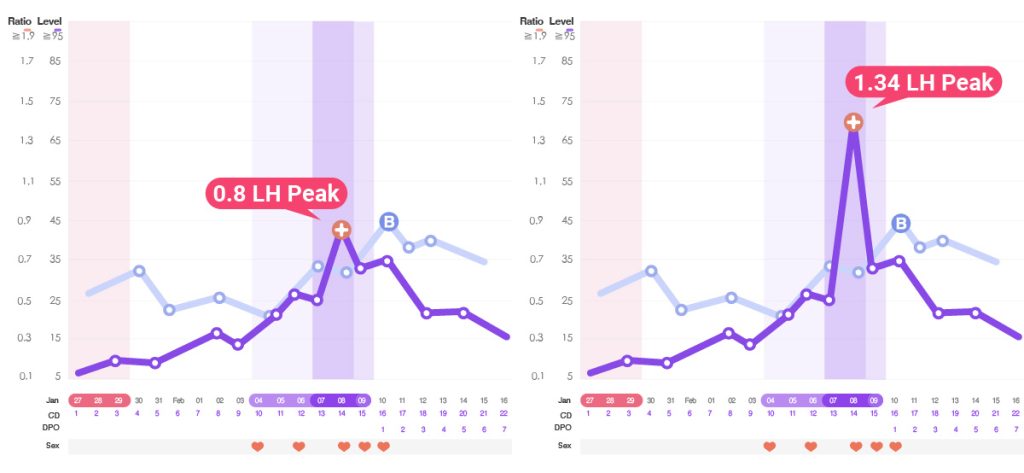
Premom gets to know you and your cycle the more you log! If the highest LH level in your previous cycle was below a T/C ratio of 0.8, then the app will adjust to the following:
Less than 0.5 = Low
Greater than or Equal to 0.5 = High / Peak
Tip: Keep testing after you think you’ve found your LH peak!
In these circumstances, once a ratio reaches 0.5 in the current cycle, the app begins identifying the “peak”, and automatically marks the highest ratio value as the peak. Keep testing until your levels are done rising and begin to drop again. As you continue to test, the app adjusts and chooses the highest ratio value in that ovulation cycle as your peak for the cycle.
If you are still having difficulty finding your LH peak, a quantitative ovulation test may help. Since these particular tests measure the amount of LH present in your urine rather than comparing the test and control line, it can prove easier to find your peak and pinpoint ovulation day.
What Are the Two LH Surge Patterns?
With consistent testing during your fertile window, you’ll be able to see which LH surge pattern you have. Knowing your pattern helps you understand your fertility and when to time sex to get pregnant.
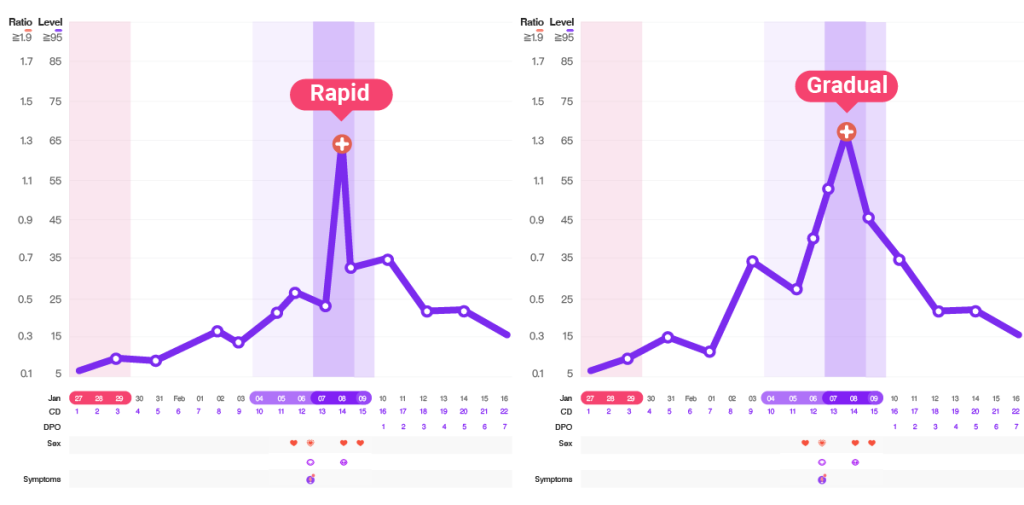
There are two common LH surge patterns: Gradual (high for 2-6 days) or Rapid (< 1 day).
Gradual Onset
LH levels rise slowly over a period of 2-6 days before reaching a peak.
Testing Tips
- Early Detection: Start testing daily after your period ends. This will help you catch the beginning of the gradual rise.
- Track Incremental Changes: Premom’s Ovulation Test Gallery monitors daily test results to identify the gradual increase in LH. This can help you predict when you’ll reach your peak.
Rapid Onset
LH levels spike sharply and peak within less than a day. This rapid increase can be challenging to detect if you’re not testing frequently.
Testing Tips
- Frequent Testing: Test at least twice a day during your fertile window – morning and evening – to catch the brief LH surge. Increasing the frequency of testing is crucial to detect the rapid spike.
- Set Alarms: Use alarms or reminders to test at regular intervals, especially during the day when you might be busy, to ensure you don’t miss the short surge.
Monitor Secondary Symptoms: Pay close attention to secondary signs of ovulation, such as changes in cervical mucus or ovulation pain, which might coincide with the rapid LH surge.
I have low LH levels — Did I ovulate?
It is possible you still ovulated, even though your highest recorded test levels are lower than average, it doesn’t necessarily mean anything was wrong with your cycle. It is likely for some women to fall into a lower spectrum of LH metabolite levels and this is not a major cause for concern as long as an LH peak is being identified in relation to your other testing days.
The Premom app automatically selects your high / peak even if it falls below 0.80, as long as it is 0.50 or higher.
If you’ve caught only low levels this cycle, it also is possible you may have missed your peak. You may have a rapid LH onset pattern that makes it harder to catch your peak. If this is the case in your cycle, the way you utilize ovulation tests makes a huge difference. Consider testing two times a day between 10 am and 8 pm next cycle to ensure you aren’t missing a rapid LH surge.
Other reasons for these low levels could be not testing enough during your cycle or the day — or overly diluted urine samples. Consider keeping your water intake consistent while ovulation testing.
How Do I Compare Cycles
Although ovulation test results vary from cycle to cycle, there is an easy way to make a comparison on the app! When you capture an image of your ovulation test using the Premom app, the app automatically assigns a numerical result for your ovulation test and you may compare your current cycle with the previous one.

Meanwhile, you can also access a physician-designed cycle comparison report in our Premom Premium Membership. The comparison report provides you with additional insights into your unique patterns in fertile windows, moods, and symptoms by comparing your past cycles. By identifying unique patterns, users (especially those with irregular cycles and PCOS) can more accurately identify their fertile windows with ease or identify techniques to improve their testing practices.
Premom members also receive a cycle comparison report after at least 2 cycles of tracking with a Premom app and can view the results of up to 3 cycles compared to each other at a time! You can use this cycle comparison to look for patterns that occur for multiple cycles
How to Double-Check and Confirm Your Ovulation Test Results
Ovulation testing helps you predict when ovulation will occur, but it does not guarantee that it will actually happen. For this reason, it is recommended to use a secondary tracking method throughout your cycle to ensure you don’t miss your true fertile window.
Here are two tracking methods to help confirm ovulation:
- Basal body temperature (BBT): By tracking your temperature each morning with a basal thermometer, like this Easy@Home Bluetooth Basal Thermometer that pairs with the Premom app, you will see a sustained 0.5-1ºF rise in your baseline temperatures within 1-3 days after ovulation indicating a hormonal shift.
- Progesterone (PdG) tests: The hormone progesterone becomes dominant after ovulation to prepare your body for a potential pregnancy. If your progesterone test is positive, you can feel more confident ovulation was successful.
Baby dust is headed your way!
Frequently Asked Questions about Low LH Levels
Question: Why is my LH level so low?
Answer: Some users can have their maximum LH level lower than 0.5 and ask themselves, “Why am I not Ovulating? The reality is that’s just normal for your cycle and you are still ovulating. As long as you see a peak compared to your other testing days and notice a rise in BBT about 24 hours after ovulation based on your LH peak, you likely ovulated.
On the other hand, it could be you missed your LH peak. If you still aren’t sure if you have ovulated, consider tracking your basal body temperature to confirm your ovulation.
Question: What is the minimum LH level needed for ovulation?
Answer: There is no perfect LH level needed to ovulate, every woman and every cycle is different. Most women experience their LH peak around .08-1.0, however, many women will successfully ovulate with a lower or higher LH level. The important thing is to pay attention to your last, darkest day while ovulation testing and keep testing a few days after LH peak to ensure that it is your true peak day.
Monitoring your BBT for a rise in temperature after ovulation also helps confirm your observed LH peak resulted in ovulation.
Question: What should I do if my LH surge is low?
If your LH surge is low and you never see a clear ovulation test peak, schedule a time to talk to your doctor to identify the cause of these low LH levels and the potential absence of ovulation.
Some women with longer cycles will have low days for a long time before the LH peak occurs, the first half of the cycle can vary greatly in women and may be quite long. Keep testing twice daily until you better understand your cycles to ensure you aren’t missing a rapid rise.

References
Originally published: July 22, 2022