

When trying to conceive (TTC), one of the most common concerns is timing. Couples often ask, “How can I get pregnant quickly?”. Ovulation tests provide one of the most effective ways to identify your most fertile days, increasing your chances of conception. These simple tests can help pinpoint when you’re about to ovulate, giving you a clearer window of when to try for a baby.
What Are Ovulation Tests?
Ovulation tests are home diagnostic tools designed to help identify the most fertile days of your menstrual cycle. They work by measuring a hormone called luteinizing hormone (LH), which rises sharply right before your ovary releases an egg. This is known as the LH surge, and it usually peaks about 24 hours before ovulation.
The ‘peak’ in LH, better known as the LH Peak, is your body’s way of signaling that you’re about to ovulate, making it the best time to try to conceive. There are two common types of tests available:
- Paper strip tests: These are dipped in a urine sample. The visual results appear as two lines on the strip-one for the control and another for the test (hormone being measured). You are monitoring the rise in your LH levels, looking for the test line to get darker or as dark as the control line.
- Digital tests: The results are given digitally, such as through a smiley face, indicating that ovulation is approaching. These tests can be a little more costly than the paper strips.
Why Use an Ovulation Test?
The primary reason for using ovulation tests is to better predict your most fertile days when trying to conceive. By identifying the LH surge, you can time intercourse more accurately, maximizing your chances of conception.
How Do Ovulation Tests Work?
Ovulation tests detect the concentration of LH in your urine. LH is a hormone produced by the pituitary gland that triggers the release of an egg from the ovary. Just before ovulation, your body releases a surge of LH, known as the “LH surge,” which prompts ovulation. They are designed to catch this surge, indicating that ovulation is likely to happen within the next 24 to 36 hours.
When the test detects a rise in LH, it means you’re nearing the optimal time to try for a baby. However, it’s important to note that ovulation tests do not predict the exact moment you will ovulate, but rather, they give a window of time when ovulation is expected to occur soon.
Why Taping Test Strips Isn’t Ideal
You may have seen some people taping their ovulation test strips to a piece of notebook paper to monitor the progression of their LH surge. While this method can provide some insight, it’s not always accurate or reliable due to factors like urine dilution, misinterpreting faint lines, or having to go back and read a dry test result.
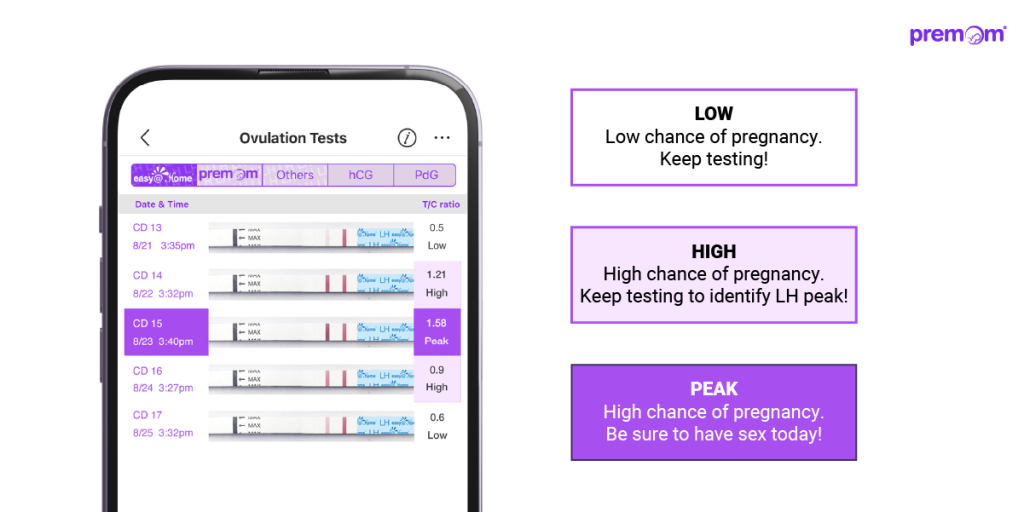
A better solution is to use an app like Premom, which allows you to easily take a picture of your test results from your phone and it will automatically quantify your test results. No more guessing when your fertile days are. Premom offers a more accurate reading and charting of your fertility patterns over time.
How to Use Ovulation Tests Properly
To get the most accurate results from ovulation tests, it’s important to understand how to use them correctly:
- Know your cycle: Ovulation tests should be used after your period ends through the middle of your cycle, usually ovulation happens around cycle day 14 if you have a 28-day cycle. If your cycle is longer or shorter, adjust accordingly.
- Test regularly: Since LH levels rise and fall quickly, it’s essential to test every day around the same time. When you enter your predicted fertile window, you can test twice per day, once midday and once in the evening.
- Track the progression: Don’t rely on a single ovulation test result. A single test alone can’t tell you when you’ll likely ovulate. You need to track your LH levels over several days to see the LH progression and identify your LH peak. Using a smart ovulation test reader, like Premom, can help you automatically interpret and track your LH test line progression while visually charting your LH pattern next to other fertility signs.
- Don’t use first-morning urine: Unlike pregnancy tests, it’s better to avoid testing with your first-morning urine for ovulation tests. The luteinizing hormone takes time to build up in your system. Typically this sample is more concentrated from holding your bladder all night.
- Combine with other tracking methods: For the most accurate prediction, consider using ovulation tests along with other fertility tracking methods like basal body temperature tracking or cervical mucus monitoring.
When Should You Start Taking Ovulation Tests?
We recommend you start using ovulation tests the day your period ends until you have confirmed ovulation. Typically, ovulation happens in the middle of the cycle, so for a typical 28 day cycle, ovulation is likely around day 14. Of course, not everyone will have a 28 day cycle. If your cycle is shorter or longer, you may need to adjust by a few days.
Once you get a positive ovulation test result, indicating an LH surge, continue testing for a few more days to ensure you catch the peak and see levels return to normal. It’s also beneficial to test at the same time each day, although testing twice a day—once mid-day and once in the afternoon—can help you catch a fleeting LH surge if you tend to ovulate quickly.
What Does a Positive Ovulation Test Mean?
A positive ovulation test means that your LH levels have surged, and ovulation is likely to occur within the next 24 to 36 hours. This is your most fertile window, and having intercourse during this time increases your chances of conception. However, it’s crucial to remember that a positive test doesn’t guarantee ovulation will occur, but it indicates that your body is preparing to release an egg.
Comparing Ovulation Tests to Other Fertility Tracking Methods
Ovulation tests are one of many ways to track fertility. Here’s how they compare to other well-known cycle tracking methods:
Ovulation Tests vs Period Tracking
Period tracking apps help you estimate when you might ovulate, but they rely on average cycle lengths and past data, which can vary for a person from month to month. Ovulation tests, on the other hand, provide real-time data on your LH surge, making them more reliable for predicting ovulation.
Ovulation Tests vs Basal Body Temperature Tracking (BBT)
BBT tracking requires you to take your temperature every morning before getting out of bed. While it can confirm that ovulation has occurred, it only shows this after the fact. Ovulation tests predict ovulation before it happens, making them more useful for timing intercourse, while BBT helps to confirm ovulation after the fact.
Ovulation Tests vs Cervical Mucus Tracking
Observing changes in cervical mucus can help predict ovulation, but it requires daily attention and can be subjective. Ovulation tests offer a more objective measure of fertility by detecting the LH surge, however, it is a good recommendation to use these two methods together.
How to Know When You Ovulate
One of the best ways to know when you are ovulating is by using ovulation tests and uploading them to the free Premom Ovulation Tracker app. Premom will help you have your highest chance at a natural pregnancy by guiding you through a simple 3-step approach to achieve a Green Cycle. Green Cycles in Premom means you gave yourself the best chances to conceive that cycle.
In our recent data study, we found that users who achieved Green Cycles had a 287% higher pregnancy rate compared to those only logging their period.
How Do You Get a Green Cycle?
Premom’s algorithm determines a ‘Green Cycle’ when you complete the following 3 steps:
- You upload your ovulation tests or log your basal body temperature to the Premom app.
- You keep uploading test results or logging temperatures until Premom finds your LH peak or BBT spike.
- You have intercourse on any of the days when Premom shows ‘Peak Fertility’ or “Ovulation Day’ right on the top of your app’s homepage.
Achieving all three steps will help you get a Green Cycle, which gives you the best chance of pregnancy with Premom.
Here’s what the other cycle statuses mean:
Yellow: You’ve completed the first and second steps.
Gray: You’ve completed the first step.
White: No ovulation tests or basal body temperature records were entered during this cycle.
You can easily check your ‘Cycle Status’ on the app’s homepage to know exactly what actions to take next on your journey towards pregnancy.
FAQs
Will an Ovulation Test Be Positive if You’re Not Ovulating?
Ovulation tests can sometimes give false positives due to other conditions that can cause elevated LH levels, such as PCOS or certain medications. However, a consistent rise and peak in LH levels generally indicates that ovulation is imminent.
Should You Test Ovulation Twice a Day?
Testing twice a day, once in the morning and once in the afternoon, can help you catch the LH surge if it’s short. Some women have brief surges, and testing twice a day helps to ensure you don’t miss the surge. We recommend testing twice per day when you are in your expected fertile window so you don’t miss that peak.
Are Ovulation Tests Accurate?
These tests are generally reliable but can be influenced by factors like diluted urine or improper testing techniques. Following the manufacturer’s instructions and using an ovulation app, like Premom, to help track your results can improve accuracy.
Can an Ovulation Test Be Wrong?
While ovulation tests are usually accurate, there are circumstances where they may give incorrect results. For example, hormonal imbalances, such as those caused by PCOS, can lead to false positives. Always combine test results with other fertility indicators for the best accuracy.
Let’s Review
Ovulation tests are a powerful tool in your fertility toolkit. They help you pinpoint when ovulation is going to occur and can improve your chances of conception. By using them correctly and understanding how they compare to other fertility tracking methods, you can increase your chances of getting pregnant. Start using them after your period ends, in combination with cervical mucus tracking, basal body temperature, and of course the Premom app!


