

Have you gotten hCG results that seem surprisingly high, leaving you wondering if you might be carrying twins? If you’ve recently received twin hCG levels that look different from what you expected, you’re not alone in feeling curious about what these numbers actually mean.
Here’s what you should know: approximately 3.1% (or roughly 31 per 1,000 live births)births in the U.S. are twin births. When you’re carrying twins, hCG levels at 14 days post-embryo transfer are higher. These numbers can vary quite a bit between different women, though. Some twin pregnancies show hCG levels up to twice as high as single pregnancies.
During those early weeks, your body produces human chorionic gonadotropin (hCG) at a rapid pace. Levels typically double every 48 to 72 hours. With twin pregnancies, this increase can be even more dramatic—some studies have found that hCG levels more than doubled for twins compared to singletons.
What does this mean for you? While you wait for ultrasound confirmation, understanding your hCG levels can help ease some of that early pregnancy anxiety. Throughout this article, we’ll walk through typical twin hCG ranges from weeks 3-8 and show you how they compare to singleton pregnancies. Most importantly, you’ll learn why a single hCG reading isn’t enough to confirm twins and how to use your Premom chart to track and interpret these levels effectively.
Remember, your body is already doing amazing work, whether you’re carrying one baby or two. These numbers are just one piece of your unique pregnancy story.
Twin hCG Levels Chart – Key Takeaways
Understanding twin hCG levels can help ease early pregnancy anxiety, but remember that trends matter more than individual numbers when tracking your pregnancy journey.
- Twin pregnancies typically show hCG levels 30-50% higher than singletons, but significant overlap exists between ranges
- hCG doubling every 48-72 hours matters more than any single measurement for confirming healthy pregnancy progression
- High hCG alone cannot confirm twins – ultrasound between 6-10 weeks provides definitive twin diagnosis
- Use Premom app to track and visualize your hCG trends through test line progression for better insights
- Stop worrying about hCG numbers after your first ultrasound confirms pregnancy status around 8 weeks
- While elevated hCG levels might hint at twins, only ultrasound technology can provide the definitive answers you’re seeking. Focus on maintaining healthy patterns rather than obsessing over individual test results during this exciting but uncertain waiting period.
The role of hCG in early pregnancy

Human chorionic gonadotropin (hCG) might be the first signal telling you that you’re pregnant. Before we look at twin-specific patterns, let’s explore what this hormone actually does and why it matters so much during those early weeks.
What is hCG and why it rises
hCG is a hormone produced by cells that eventually form the placenta. These cells, called trophoblasts, begin making hCG shortly after a fertilized egg implants in your uterine lining. The hormone first appears in your blood as early as 10 days after conception, with levels typically doubling every 48-72 hours during the first six weeks.
Your hCG levels rise rapidly throughout your first trimester, generally peaking between 8-11 weeks of pregnancy, before gradually declining and plateauing for the remainder of your pregnancy. This pattern explains why many pregnancy symptoms feel most intense during those initial weeks.
How hCG supports progesterone production
Think of hCG as your body’s pregnancy maintenance signal. After implantation, hCG tells the corpus luteum (the empty follicle where your egg was released) to keep producing progesterone. Essentially, hCG sends a message saying, “Don’t stop—there’s a pregnancy to support!”
Progesterone helps thicken your uterine lining to create a nurturing environment for your embryo. Without hCG’s supportive role, progesterone production would drop, potentially leading to pregnancy loss. Once the placenta fully develops (around 8-12 weeks), it takes over progesterone production
Why doctors monitor hCG levels
Doctors may check your hCG levels to:
- Validate pregnancy (starting levels above 25 mIU/mL that continue to increase typically indicate pregnancy)
- Assess pregnancy viability through rising patterns
- Help determine gestational age
- Identify potential complications like ectopic pregnancy or miscarriage
When it comes to twins specifically, tracking hCG can provide early clues, though remember that levels vary widely between individuals—trends matter more than single numbers.
Types of hCG tests: qualitative vs. quantitative
Two main types of hCG tests exist, each serving different purposes:
Qualitative tests simply detect whether hCG is present in your blood or urine—essentially answering “pregnant or not pregnant?” These include home pregnancy tests and some blood tests, providing a simple positive or negative result.
Quantitative tests (sometimes called beta hCG tests) measure the exact amount of hCG in your blood. These tests provide numerical results in milli-international units per milliliter (mIU/mL), allowing doctors to track how your levels change over time—particularly valuable when monitoring twin pregnancies.
Twin hCG levels by week: What to expect
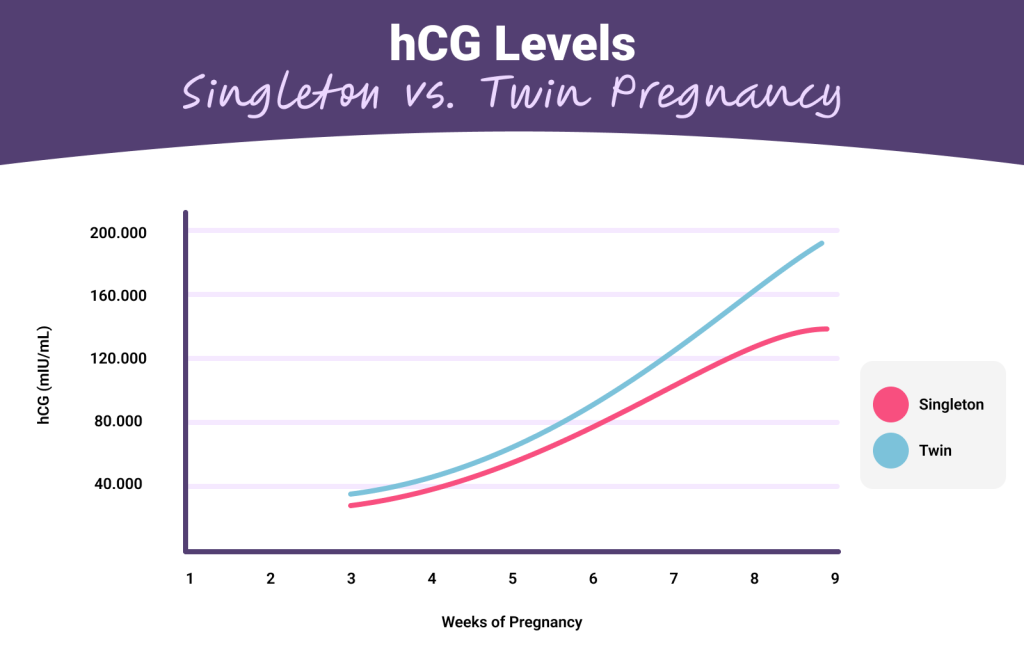
Those high hCG numbers you’re seeing might have you wondering about twins. Let’s break down what twin hCG levels typically look like as your pregnancy progresses week by week.
hCG levels for twins at 4 weeks
At 4 weeks, twin hCG levels often range between 100-1,200 mIU/mL, which is noticeably higher than singleton ranges of 5-426 mIU/mL. Real twin parents have shared experiences like having an hCG of 854 at 4 weeks, then watching it jump to 1,855 just two days later. This rapid increase is exactly why tracking with reliable pregnancy tests can be so helpful. Get Easy at home pregnancy test strips to monitor these early changes effectively.
Twin hCG levels chart by week
| Week | Singleton Range (mIU/mL) | Twin Range (mIU/mL) |
| 3 | 5-50 | 10-100 |
| 4 | 5-426 | 200-7,000 |
| 5 | 18-7,340 | 1,000-15,000 |
| 6 | 1,080-56,500 | 7,500-200,000 |
| 7-8 | 7,650-229,000 | 30,000-400,000+ |
hCG levels for twins at 5 weeks
By 5 weeks, twin hCG levels typically reach 1,000-15,000 mIU/mL. A 2020 meta-analysis found median hCG at 5 weeks to be 12,700 IU/L in twins versus 8,100 IU/L in singletons—a 56% difference. One twin mom reported an hCG value of 16,378 at week 5, showing just how high these numbers can climb.
Twin hCG levels at 6 weeks and beyond
At 6 weeks, twin hCG levels can soar between 7,500-200,000 mIU/mL. Some moms have reported extraordinary numbers—one had 185,663 at 6 weeks, 3 days. After 8 weeks, levels often exceed 200,000 mIU/mL before peaking around weeks 9-11.
How twin hCG levels compare to singletons
Twin pregnancies typically produce hCG levels 30-50% higher than singleton pregnancies. This happens because each baby has their own placental tissue producing the hormone. Twin pregnancies also demonstrate shorter doubling times—approximately 1.4 days between 4-6 weeks compared to 1.8 days for singletons.
Do fraternal and identical twins differ in hCG?
The type of twins doesn’t significantly impact hCG levels. Research suggests that chorionicity (number of placentas) influences hCG more than zygosity (whether twins are identical or fraternal). What matters more is how many placentas are producing hormones, not whether the twins share identical DNA.
What high hCG levels can and can’t tell you
Seeing high numbers on your test results might have you dreaming about twins, but here’s the reality: hCG levels alone can’t definitively tell you if you’re carrying two babies. Let’s break down what these numbers actually mean—and what they don’t.
Do higher hCG levels always mean twins?
Even though twin pregnancies often show higher hCG values, there’s substantial overlap with singleton ranges. Many women carrying just one baby naturally produce hCG at the upper end of normal ranges. About 15-20% of women with singleton pregnancies actually have hCG levels that fall within typical twin ranges. This means a single elevated reading isn’t enough to confirm twins.
Other reasons for elevated hCG
High hCG doesn’t automatically signal twins. Your elevated numbers could mean:
- You’re further along than you calculated
- Molar pregnancy (abnormal tissue growth that needs medical attention)
- Chromosomal variations like Down syndrome
- Certain types of cancer that produce hCG
Why trends matter more than individual numbers
Here’s what’s more important than any single measurement: the pattern of how your hCG rises. Healthy pregnancies typically show consistent doubling patterns during early weeks, regardless of whether you’re carrying one baby or two. With twins, this doubling might happen slightly faster, but it’s the consistent pattern that matters most.
You can log your results in Premom to see these important trends visually—this takes the guesswork out of interpreting your numbers.
When to stop worrying about hCG
Once your first ultrasound confirms your pregnancy status (usually around 6-10 weeks), hCG monitoring becomes much less critical. At this point, seeing heartbeats and visual confirmation become more important than blood test numbers. After 8-11 weeks, hCG naturally peaks anyway, so further testing becomes less informative.
The bottom line? While your hCG levels can provide clues about your pregnancy, they’re just one piece of the puzzle. Your ultrasound will give you the definitive answers you’re looking for.
How to trackyour hCG levels
When you’re tracking hCG levels, having the right tools and knowing what to look for can make this whole process feel much less overwhelming.
Using Premom to log and visualize hCG
Tracking your pregnancy test line progression give some women reassurance that your hCG levels are rising. Scan your pregnancy test and log in Premom app to create visual charts and trend comparisons that help you monitor your doubling pattern. The app captures images of your tests, building a visual record as test lines darken every 2-3 days.

What makes this especially helpful? You can see your progression over time rather than trying to remember how yesterday’s test compared to today’s. Download the app for additional resources, videos, blogs and community support from other moms who may be experiencing twin pregnancies too.
When to consult your doctor
Contact your healthcare provider right away if you notice any of these patterns:
- Your hCG levels aren’t doubling every 48-72 hours
- You experience unusual bleeding or severe cramping
- Your levels plateau before 8 weeks
- You have symptoms of ectopic pregnancy
Keep in mind that doctors don’t routinely check hCG throughout pregnancy unless there’s a specific concern.
How ultrasound confirms twin pregnancy
An early ultrasound between 6-10 weeks gives you the most accurate twin diagnosis. Unlike hCG tests that only show hormone levels, ultrasound directly shows your babies, confirms heartbeats, and determines if twins are identical or fraternal based on how the membranes are positioned. After confirmation, identical twins typically need monitoring every two weeks while fraternal twins need checks every four weeks.
This is when you’ll finally get those definitive answers you’ve been waiting for.
Tips for staying calm while waiting
Since many women experience high stress during these waiting periods, here are some strategies that can help:
- Keep up your normal routine instead of putting everything on hold
- Try outdoor activities that help encourage positive thoughts
- Avoid searching unreliable websites for hCG information
- Focus on blood test results rather than obsessing over home tests
Remember, this waiting period is temporary. Soon enough, you’ll have clear answers about your pregnancy, and these early weeks of uncertainty will just be part of your story.
Conclusion
Understanding your hCG levels can feel overwhelming when you’re wondering if those higher numbers might mean twins. While twin pregnancies typically show hCG levels 30-50% higher than singleton pregnancies, these numbers alone don’t tell the complete story. There’s significant overlap between singleton and twin hCG ranges, which means a single elevated reading isn’t enough to confirm twins.
What matters most is how your levels change over time rather than any individual measurement. Healthy pregnancies show hCG doubling every 48-72 hours during early weeks, whether you’re carrying one baby or two. This pattern gives you far more valuable information than any single number.
Your journey through these early pregnancy weeks brings excitement mixed with anxiety—and that’s completely normal. Tracking your results with tools like the Premom app can help ease some worries by showing you your hCG progression visually. When you can see your test results charted over time, it offers reassurance that your hormone levels are rising appropriately.
You’ll reach that important ultrasound appointment between 6-10 weeks, where you’ll finally get visual confirmation about your pregnancy. Until then, try focusing on your normal routine instead of constantly wondering about your numbers.
The waiting period challenges even the most patient people, but take comfort knowing that whatever your hCG levels indicate, they’re just one piece of your unique pregnancy story. Your body is doing remarkable work right now, whether you’re nurturing one baby or possibly two. Soon enough, that ultrasound will provide the definitive answers you’re looking for, and this period of uncertainty will become just a memory in your journey to parenthood.
Twin hCG Levels Chart – FAQs
While twin pregnancies often show hCG levels 30-50% higher than singleton pregnancies, there’s significant overlap in ranges. A single elevated hCG reading isn’t enough to confirm twins. Doctors consider the trend of hCG increase more important than individual numbers.
Common early pregnancy symptoms like nausea, breast tenderness, and fatigue may feel more intense in twin pregnancies due to higher hCG levels. However, symptom intensity varies greatly among individuals and isn’t a definitive indicator of twins.
In twin pregnancies, hCG levels may double slightly faster than in singleton pregnancies. While singleton hCG typically doubles every 48-72 hours, twin pregnancies might show even quicker doubling times. However, the pattern of increase is more important than the exact rate.
An ultrasound between 6-10 weeks of pregnancy provides the most accurate diagnosis of twins. Unlike hCG tests, ultrasound can directly visualize the number of embryos, confirm heartbeats, and determine if twins are identical or fraternal.
Using tools like the Premom app can help you track and visualize your hCG progression. The app allows you to log your pregnancy test results, creating a visual chart of your hCG increase over time. This can provide reassurance about your pregnancy’s progression while waiting for ultrasound confirmation.
References
Human Chorionic Gonadotropin (hCG): The Pregnancy Hormone. American Pregnancy Association. Updated May 20, 2024. Accessed December 18, 2025. https://americanpregnancy.org/getting-pregnant/hcg-levels/
Chauhan MB, Lakra P, Nanda S, et al. Role of early serum beta human chorionic gonadotropin measurement in predicting multiple pregnancy and pregnancy wastage in an in vitro ET fertilization cycle. J Hum Reprod Sci. 2013;6(4):257-261. doi:10.4103/0974-1208.126296
National Center for Health Statistics. FastStats: Multiple Births. Centers for Disease Control and Prevention. Updated May 9, 2024. Accessed December 18, 2025. https://www.cdc.gov/nchs/fastats/multiple.htm