
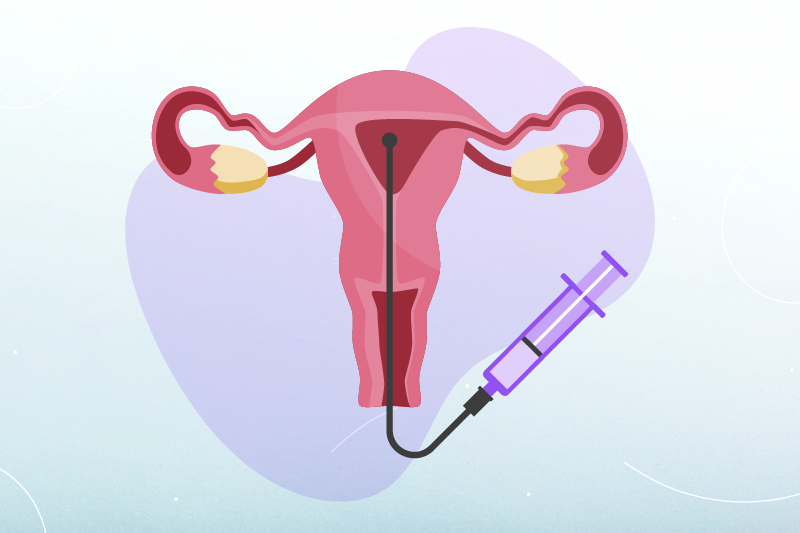
If you’ve been trying to get pregnant for a while and are considering fertility assistance like intrauterine insemination (IUI), we want to help you understand your options. This way, you can advocate for yourself and make informed decisions about the next steps in your fertility journey!
What is an IUI? What does the process entail?
Intrauterine Insemination (IUI) is an assisted reproduction technique performed in-office by a fertility specialist. The procedure involves placing washed sperm directly into the uterus using a small, flexible catheter to increase the chances of fertilization by positioning the sperm closer to the egg. IUI is less invasive and more affordable than in vitro fertilization (IVF) and is often tried before progressing to IVF.
The fertility specialist times the insemination based on your ovulation date. It can be a natural cycle without fertility medications or a medicated cycle using fertility drugs to stimulate and trigger ovulation. You and your specialist will discuss and decide the best approach. This is a very time-sensitive procedure as your doctor will want to ensure the sperm are in the uterus just prior to or during ovulation. This is why it is so important to use ovulation tests during your IUI cycle to ensure you don’t miss your fertile window – we will get to this shortly!
IUI Success Rates
There is a lot that goes into success rates for a single cycle IUI and many factors to consider, however commonly cited success rates for an IUI range from about 10-20% success per cycle. That may seem low, but there are a few factors that go into consideration for these success rates including age, diagnosis, and the timing of the IUI. It’s also important to note that at the peak of fertility, when trying to conceive through intercourse, there is also only a 10-20% chance of conceiving naturally each cycle, dependent on age.
Your doctor will discuss diagnoses that may affect your IUI success rates, such as unexplained infertility, diminished ovarian reserve, PCOS, endometriosis, or male factor infertility. These conditions may impact success rates. Your doctor will provide more details on your case and predicted outcomes. Always ask questions or seek a second opinion. You know your body and desires best, so advocate for your needs.
To optimize your chances of success with IUI, ensure accurate timing of the insemination. This time-sensitive procedure requires placing sperm in the uterus just before or during ovulation. Once ovulation occurs, the mature egg has less than 24 hours to be fertilized by sperm.
Timing the IUI correctly is crucial. Ovulation tests can help!
After ovulation, the mature egg has less than 24 hours to meet sperm for fertilization. Schedule the insemination at the time of egg release from the ovary.
As ovulation approaches, the hormone Estrogen begins to rise and once it is sufficiently high, it triggers a sudden release of LH (Luteinizing Hormone). This LH surge triggers the final maturation and releases an egg from the ovary.

LH surges just before ovulation, shown in purple on the graph above. Ovulation test strips, or Ovulation Predictor Kits (OPKs), detect this hormone in urine at home. After detecting an LH surge, ovulation occurs 24-36 hours later, as shown above.
Preparing For The IUI
As ovulation approaches, the hormone Estrogen begins to rise and once it is sufficiently high, it triggers a sudden surge of LH (Luteinizing Hormone). This LH surge triggers the final maturation and release of an egg from the ovary. You can detect this hormone in urine at home using an ovulation test. After detecting an LH surge, ovulation occurs 24-36 hours later.
Your doctor may suggest that you use ovulation kits to appropriately find your LH peak to accurately time the IUI. Or, they may suggest monitoring through blood tests and ultrasounds depending on your individualized protocol. If you are using Ovulation Predictor Kits (OPKs), you want to make sure that you call your doctor as soon as you see your peak so you can schedule your insemination.
When should you start ovulation testing with IUI?
To make sure you won’t miss your LH surge, here are some suggested ways to get started.

We recommend testing anytime between 10:00 AM-8:00 PM, as this is when LH levels tend to be the highest in the urine. Learn more about how to use and interpret ovulation tests.
The Day of IUI
An IUI visit usually takes less than 30 minutes and happens at the clinic. Right before the IUI, the lab will wash and prepare the semen sample, whether it’s from your partner’s or a donor’s sperm. The sperm washing separates the high quality sperm from any bacteria or low quality sperm that may be present and will provide a concentrated sample of healthy sperm.
During the procedure, you will lie on the exam table as you would for a pap smear. The provider will insert a small, flexible catheter past the cervix and into the uterus to place the sperm near the fallopian tubes, increasing the chances of fertilization. The procedure should not be painful, but always inform your provider of any discomfort.
After The IUI
Always be sure to discuss any precautions or do’s & don’ts with your provider after the insemination and make sure to follow their guidelines over the next two weeks. Since an IUI still requires natural conception, wait about 12-14 days past ovulation (DPO) before taking a pregnancy test, as implantation can occur anywhere from 6-12 DPO.
3 Tips for an IUI
- Don’t be afraid to ask questions!
An IUI can be very intimidating and overwhelming, especially if this is your first. Asking questions and becoming more comfortable with how the procedure works and what you should expect may help relieve any stress or anxiety you may have about the IUI. - Eat healthy!
Focusing on eating whole foods including fruits, vegetables, lean proteins, and whole grains are a great way to support your fertility. Stay hydrated by drinking plenty of fluids, especially water! - Find ways to de-stress
Stress does not directly cause infertility, however, stress can affect the reproductive hormones, which can affect our fertility. The dreaded two week wait can be very stressful, especially if you are tempted to take a pregnancy test early. Find a few activities to focus on during your two week wait that may help with stress, such as going to acupuncture, doing some light exercises or trying a new recipe or two.
In need of ovulation tests? Premom Quantitative Ovulation Test Strips and Easy@Home ovulation predictor kits work best with the Premom app. They have trusted quality and are super easy to use! Download the free Premom app to get started!
References
Elkholi DGEY, Nagy HM. The impact of timing of insemination in relation to ovulation on the cycle pregnancy rate of intrauterine insemination and intrauterine tuboperitoneal insemination in unexplained infertility. Middle East Fertil Soc J. 2016;21(1):4-10. doi:10.1016/j.mefs.2015.03.001.
Yavuz, A., Demirci, O., Sözen, H., & Uludoğan, M. (2013, March). Predictive factors influencing pregnancy rates after intrauterine insemination. Iranian journal of reproductive medicine.
https://www.ncbi.nlm.nih.gov/pmc/articles/PMC3943223/#:~:text=Favorable patient characteristics for IUI, pregnancy rate compared with literature.
WebMD. (n.d.). 3 crucial factors that determine IUI success rate. WebMD. https://www.webmd.com/infertility-and-reproduction/what-is-iui-success
Mayo Foundation for Medical Education and Research. (2023, September 12). Intrauterine insemination (IUI). Mayo Clinic. https://www.mayoclinic.org/tests-procedures/intrauterine-insemination/about/pac-20384722


