

How old is too old to have a baby? The honest answer: there’s no single cutoff age. While fertility naturally declines with age—noticeably after 35 and more dramatically after 40—thousands of women successfully have healthy babies well into their 40s. The key difference? They understand how their fertility changes, track their cycles strategically, and work proactively with healthcare providers when needed.
This guide walks you through everything you need to know about getting pregnant after 35: how fertility shifts at different ages, real risks versus unnecessary worry, proven ways to boost your conception chances, and the treatments and support available when you need them. Whether you’re 32 and planning ahead or 41 and actively trying, you’ll find practical strategies and evidence-based information to help you make confident decisions about your fertility journey—plus access to a community of over 10 million women on Premom who understand exactly what you’re going through.
Key Takeaways
✓ Fertility declines gradually with age, but pregnancy remains possible into your 40s with proper planning and medical support
✓ Track ovulation using Premom to identify your exact fertile window each cycle—especially critical after 35 when timing matters most
✓ Consult a fertility specialist after 6 months if you’re 35-39, or immediately if you’re 40+ to explore your options
✓ Modern treatments like IUI, IVF, and donor eggs offer viable pathways when natural conception is challenging
✓ Focus on healthy lifestyle habits: nutritious eating, prenatal vitamins, stress management, and avoiding smoking to support your fertility
✓ You’re not alone: Join Premom’s community for support, knowledge sharing, and encouragement throughout your journey
Understanding Fertility After 35
Your fertility journey doesn’t hit a wall at 35, but understanding what’s happening inside your body helps you make smarter decisions about your reproductive future.
Why fertility changes with age
You’re born with your entire egg supply—roughly 1-2 million eggs at birth. By the time you hit puberty, that number has already dropped significantly. The decline continues throughout your life, speeding up as you age.
But it’s not just about how many eggs you have left. Egg quality—how healthy and genetically stable each egg is—also changes over time. Think of it like this: eggs that have been waiting around for decades are more likely to have genetic issues than younger eggs.
Bottom line: Your eggs age with you, and both their number and quality decline over time. But this doesn’t mean pregnancy is impossible—it just means being strategic helps.
Want to understand where you stand? Take Premom’s Fertility & Conception Potential Assessment to get personalized insights about your reproductive health based on your age, cycle patterns, and health history.
How fertility changes from 30 to 40 and beyond
Your reproductive peak is in your 20s, when your chances of getting pregnant each month are at their highest. At 30, fertility begins its gradual descent, but you still have good odds of conceiving within a year of trying.
After 35, the decline becomes more noticeable. By 40, your monthly chances of getting pregnant naturally drop quite a bit, and the time it takes to conceive typically increases. Miscarriage risk also goes up with age.
What age do women stop having babies?
Menopause, when your periods stop for good, typically happens in your late 40s to early 50s. Before that, you’ll go through perimenopause, usually starting in your mid-40s (though sometimes earlier), when cycles become unpredictable.
Conception becomes increasingly challenging after 45, but pregnancy remains technically possible until menopause. There’s no absolute cutoff age for natural conception, though success rates do drop. With medical help like IVF, women can achieve pregnancy at later ages, particularly when using donor eggs.
The key is knowing where you stand so you can plan accordingly. Premom’s advanced cycle tracking helps you identify even subtle changes in your patterns—critical information when you’re working with a tighter fertility window.
Health Risks of Pregnancy After 35
Nobody likes talking about risks, but understanding what you might face helps you make informed choices about your pregnancy journey. While many women sail through healthy pregnancies after 35, knowing the potential challenges lets you prepare and get the right care when you need it.
Increased risk of pregnancy loss
The reality is that pregnancy loss becomes more likely as you get older. The risk climbs steadily with each passing year, with the most significant increases happening after 40. The main reason? Those age-related changes in egg quality that we talked about earlier.
Gestational diabetes and high blood pressure
Your body handles pregnancy differently after 35. Gestational diabetes risk increases with age, and women over 40 are significantly more likely to develop it compared to younger women.
High blood pressure during pregnancy follows a similar pattern, with risks jumping after 40. This can lead to more serious conditions like preeclampsia, which affects both you and your baby’s health.
Chromosomal Abnormalities
This is one of the most well-known age-related pregnancy risks. Down syndrome and other chromosomal conditions become more common as maternal age increases. At 25, the risk is quite low. By 35, it’s noticeably higher. At 40 and beyond, the risk increases substantially.
Why does this happen? Those eggs have been sitting in your ovaries for decades, and the longer they wait, the more likely their genetic machinery is to make mistakes during cell division.
Is 40 too old to have a baby?
There’s no universal age limit written in stone. But pregnancy after 40 does mean more doctor visits and closer monitoring. Miscarriage rates are higher, 30% compared to less than 10% when you are under 30, and you’re more likely to need a cesarean section compared to younger women.
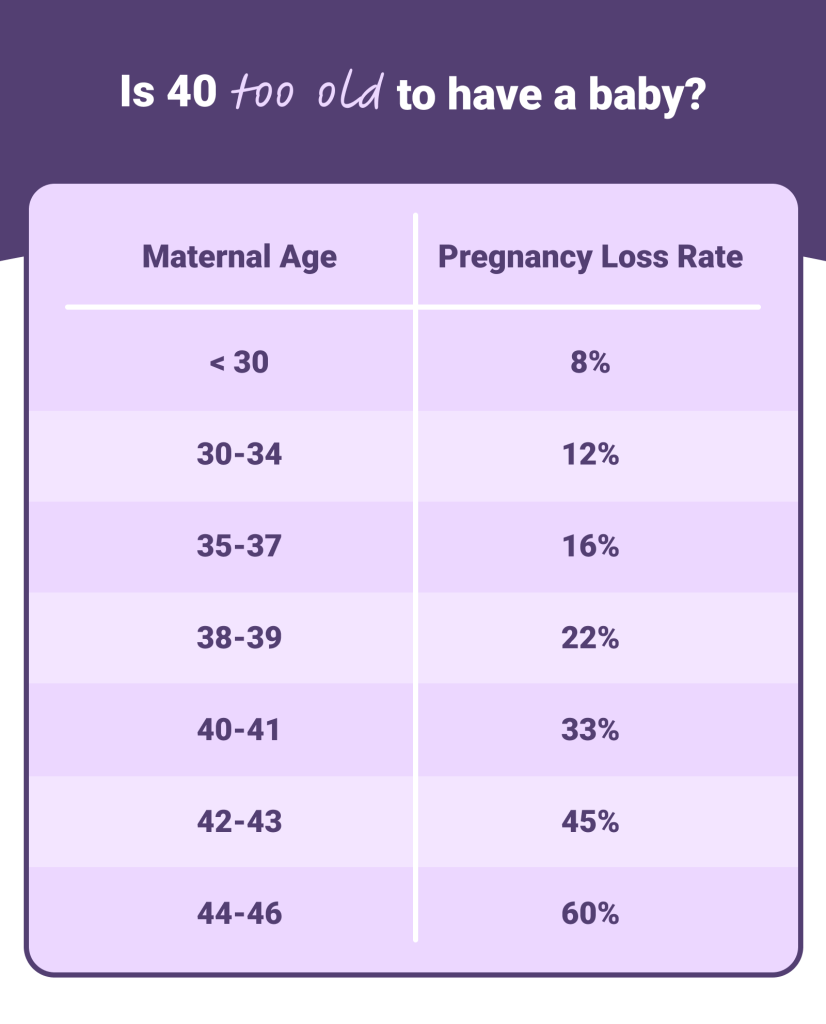
Despite these realities, thousands of women over 40 have healthy pregnancies and babies every year. Modern prenatal care offers better monitoring and support than ever before, making later-life pregnancy significantly safer than it was for previous generations.
How to Improve Your Chances of Getting Pregnant
Ready to take charge of your fertility? The good news is that many factors affecting conception are within your control, especially as you move through your mid-30s and beyond. Smart choices today can make a real difference in your chances tomorrow.
Tips for getting pregnant at 30–35
Your early 30s offer a sweet spot—your fertility is still relatively strong, giving you time to optimize your reproductive health. Start with the basics: eat plenty of vegetables, healthy fats, and whole grains. Prenatal vitamins with folic acid aren’t just for when you’re already pregnant—start taking them before you begin trying.
Stress management matters more than you might think. High stress levels can throw your cycles off track. Find what works for you, whether it’s yoga, meditation, or simply regular walks. Both you and your partner should avoid smoking and limit alcohol—both can interfere with fertility. Maintaining a healthy weight through balanced eating and moderate exercise also gives you an edge.
Tracking ovulation and identifying fertile windows
Want to increase your chances of conception? Knowing when you ovulate makes all the difference. Your fertile window spans about six days—the five days before ovulation plus the day of ovulation itself.
You have several effective tracking options:
- Ovulation predictor kits that catch hormone surges before ovulation
- Cervical mucus monitoring—look for clear, stretchy mucus that resembles raw egg whites
- Basal body temperature tracking, where your temperature rises slightly after ovulation
Here’s where Premom becomes your secret weapon: Our app combines all three methods in one place with AI-powered analysis that learns your unique patterns. Premom’s advanced algorithm pinpoints your fertile window with precision—especially valuable after 35 when getting the timing right becomes even more important.
Premom’s unique features include:
- Automatic OPK reading with photo recognition—no more squinting at test lines
- BBT charting that identifies your ovulation even when cycles are irregular
- Personalized fertile window predictions that get smarter with each cycle you track
When to see a fertility specialist
Timing your consultation can save precious months. If you’re under 35, give it a full year of trying before seeking help. Women 35-39 should see a specialist after six months of unsuccessful attempts. At 40 or older? Don’t wait—consult a fertility specialist before you even start trying.
Don’t stick to these timelines if you have irregular or absent periods, endometriosis, PCOS, previous miscarriages, or other reproductive concerns. In these cases, seek help immediately regardless of your age.
Not sure if it’s time to see a specialist? Take Premom’s Fertility & Conception Potential Assessment to evaluate your cycle health and get personalized recommendations on next steps.
Getting pregnant at 39 vs 40: what to expect
That transition from 39 to 40 marks a significant shift in fertility planning. At 39, the six-month rule still applies—but be prepared to move quickly if conception doesn’t happen. Once you turn 40, immediate consultation becomes crucial as your monthly conception chances drop to less than 10%.
This is when fertility treatments often become essential tools rather than last resorts. Options include fertility medications, intrauterine insemination (IUI), or in vitro fertilization (IVF). Whatever your age, early and consistent prenatal care sets the stage for the healthiest possible pregnancy outcome.
Fertility Treatments and Support Options
When trying naturally isn’t working after 35, modern fertility medicine steps in with real solutions. These treatments can help you work around age-related fertility challenges and bring you closer to your goal of pregnancy.
Fertility drugs and IUI
Sometimes your body just needs a little boost. Fertility medications stimulate your ovaries to release eggs, and when paired with IUI (where prepared sperm is placed directly into your uterus), you’re giving conception a head start.
Most doctors suggest trying a few IUI cycles before moving to other options, though if you’re over 40, they might recommend fewer attempts before considering IVF.
Tracking IUI cycles? Premom helps you monitor your response to medications by tracking LH surges, medication schedules, and procedure dates—all shareable with your fertility team.
IVF and donor eggs
IVF can be a game-changer after 40, especially when natural conception becomes difficult. Donor eggs can significantly boost success rates for women in their mid-40s and beyond—a decision that has helped thousands build their families.
Starting IVF or considering donor eggs? Connect with women who’ve been there in Premom’s IVF Support Community, and access expert insights through our Doctor Line for medical questions between appointments.
Egg freezing and embryo preservation
Thinking ahead? Egg freezing preserves your fertility for future use—ideally done in your early to mid-30s.
Emotional and mental health support
Let’s be honest—the fertility journey can feel overwhelming. Many women describe infertility as one of the most difficult experiences of their lives. That’s why mental health support through therapy, counseling, and support groups becomes just as important as the medical treatments themselves.
How Old Is Too Old to Have a Baby – FAQs
While pregnancy after 35 does come with increased risks, many women have healthy pregnancies and babies at this age. The key is working closely with your healthcare provider for proper monitoring and care.
The risk of Down syndrome does increase with maternal age. At 35, the risk is higher than at 25, and it continues to increase each year. However, most babies born to women over 35 are healthy.
Fertility gradually declines with age, with more noticeable changes after 35. By 40, monthly conception chances drop significantly. However, many women still conceive naturally in their late 30s and early 40s. The key is precise cycle tracking to identify your fertile window and maximize your chances each cycle.
If you’re under 35, seek help after a year of trying. For women 35-39, consult a specialist after six months. If you’re 40 or older, it’s recommended to see a fertility specialist before you start trying to conceive.
Various options exist, including fertility medications, IUI, IVF, and egg donation. The most suitable treatment depends on your individual circumstances and should be discussed with a fertility specialist.
References
American College of Obstetricians and Gynecologists’ Committee on Clinical Consensus–Obstetrics. Pregnancy at Age 35 Years or Older: ACOG Obstetric Care Consensus No. 11. Obstet Gynecol. 2022;140(2):348-366. doi:10.1097/AOG.0000000000004873.
Sunkara SK, Tarry-Adkins L, Phillips SE, et al. What is the best treatment option for infertile women aged 40 and over? Reprod Biol Endocrinol. 2013;11:26. doi:10.1186/1477-7827-11-26.
Haebe J, Martin J, Tekepety F, Tummon I, Shepherd K. Success of intrauterine insemination in women aged 40-42 years. Fertil Steril. 2002;78(1):29-33. doi:10.1016/S0015-0282(02)03168-0.
Yale Medicine. Hypertension (High Blood Pressure) During Pregnancy. Yale Medicine website. Accessed November 6, 2025. https://www.yalemedicine.org/conditions/hypertension-high-blood-pressure-during-pregnancy.