

When you’re trying to get pregnant, ovulation tests may help you better understand your ovulation patterns to get pregnant faster. If you are new to trying to conceive, ovulation tests can be confusing. So let’s take a look at how you can master these tests to more easily understand your fertility. Using reliable ovulation test strips can make tracking your fertile window simpler.
Understanding your fertile window is key when trying to conceive. The fertile window covers the five days before ovulation and the day of ovulation itself. The highest chances of getting pregnant are usually one to two days before ovulation and on the day of ovulation. Ovulation tests help you identify this window more accurately compared to relying on cycle dates alone.
1. How to Read Ovulation Tests
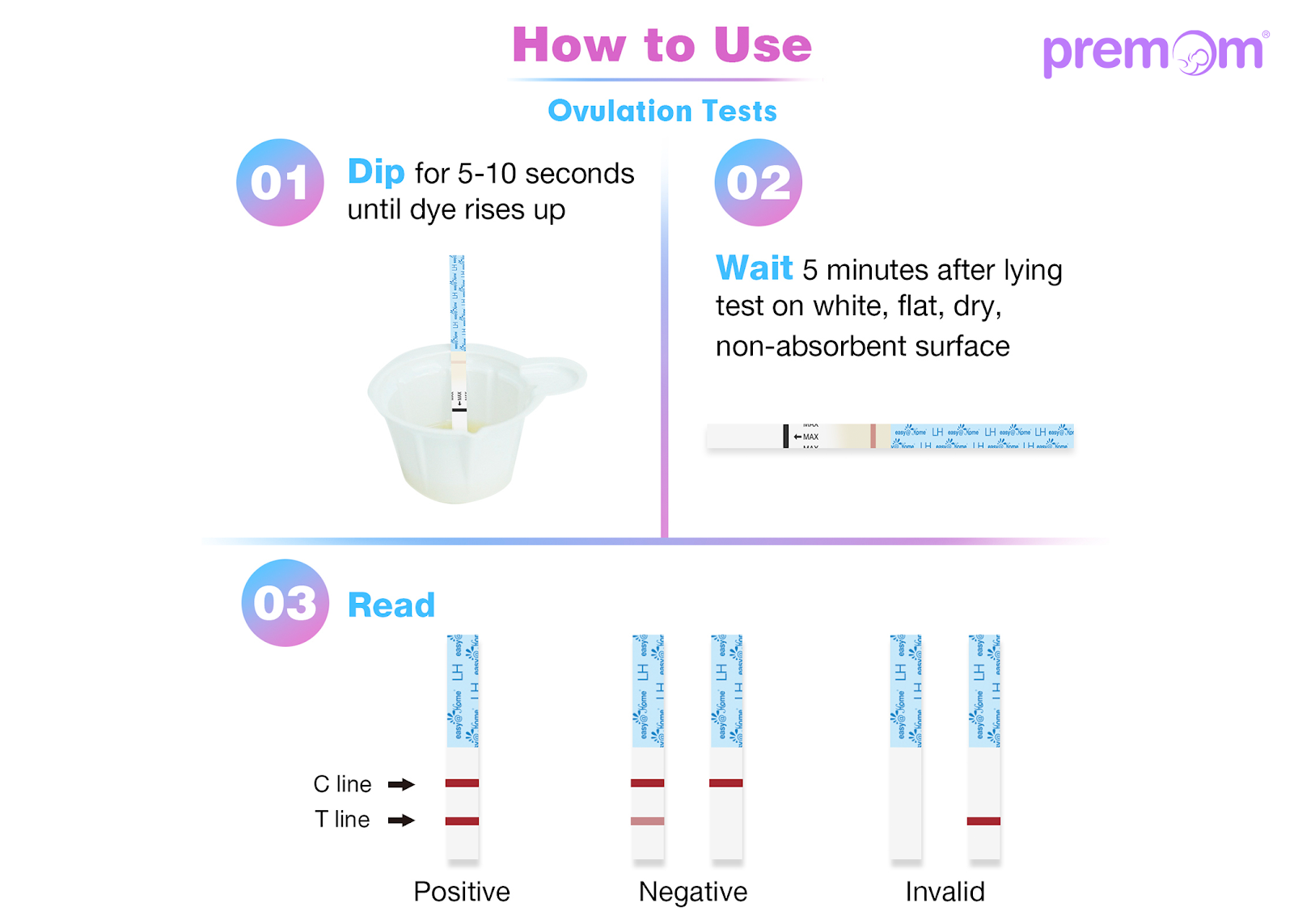
Most ovulation tests have two lines. The first line, closest to the absorbent tip of the strip, is the test line (T) and indicates your ovulation status. The second line is the control line (C) and ensures the test works correctly.
Throughout your menstrual cycle, the darkness of the test line (T) will change. It will likely be low before your fertile window, rise during your fertile window, and peak just before ovulation day. A positive result is indicated by a test line that is as dark as or darker than the control line (C). On the other hand, a negative result is indicated by a test line that is lighter than the control line.
Understanding how to read the test line correctly is essential in identifying your most fertile days and increasing your chances of getting pregnant, a positive test doesn’t indicate your LH peak day necessarily, so you’ll want to keep testing.
Step-by-Step Instructions
- Collect: Use a clean cup to collect urine. For optimal results, test between 10 AM and 8 PM, not first morning urine. The Premom Pee Collection Cup works well here and keeps things simple.
- Dip: Place the absorbent end of the test strip into the urine up to the black MAX line for 5-10 seconds, until the dye begins to move upward into the test window. Do not dip past the MAX line. Crossing this line can “flood” the test and make it invalid.
- Lay Flat: Place the strip on a clean, dry, non-absorbent surface.
- Wait: Set a timer. The Premom app includes a built-in timer on the test gallery screen.
- Read Results: Read your result within 3-5 minutes. Ignore any changes after 10 minutes, as drying may cause “evaporation lines” that can appear as false positives.
- Scan: Open the Premom app and scan your test strip immediately. Track your LH progression and view your chart daily to see your surge building and know when your best days to try are approaching.
2. My Ovulation Test Is Positive, Now What?
Normally, if a test line is as dark or darker than the control line, it is a positive result.
Actually — and fortunately — ovulation tests can tell you far more than a positive result as the tests darken with increasing LH levels, demonstrating the rise and surge of luteinizing hormone (LH) occurring before ovulation.
When testing, a positive ovulation test doesn’t always mean you will ovulate in 24-36 hours. Rather, you want to look for your LH peak. Your LH peak is the last, darkest ovulation test you have and indicates that ovulation will most likely occur 24-36 hours later.
Knowing some women may have positive test results for multiple days, while others may only have positive results for a few hours, is important in understanding your specific LH patterns. There are two types of LH surges: gradual LH onset and rapid LH onset. Monitoring your LH levels consistently over several cycles helps determine which type of LH surge pattern you have, making it easier to identify the appropriate time for testing.
If you use the Premom app, your app does all the work for you to show you when you are most fertile. Simply use your phone’s camera to take a picture of your ovulation test strip and Premom interprets the result as low, high, or peak fertility. See your fertile window and luteinizing hormone levels on one chart. No more guessing!
Once you identify your LH peak, ovulation is likely to happen within the next 24 hours. To improve your chances of getting pregnant, have intercourse on the same day as your peak and the following day. Sperm can survive in the reproductive tract for up to 5 days, while the egg survives for about 24 hours. Having sperm present before ovulation happens gives you the strongest shot.
3. What Can You Interpret from an Easy@Home Ovulation Test?
You can monitor your LH progression throughout the ovulation cycle using the ‘chart view’ in the Premom app. You’ll not only know when LH reaches a peak with a positive ovulation test strip but also learn your body’s typical ovulation pattern.
An LH surge is easily detected if it reaches the standard cutoff of 25-45 mIU/mL (a T/C ratio of 1.0 or above). However, when the LH surge doesn’t reach the standard average cutoff level, meaning the test line isn’t as dark as or darker than the control line, it’s possible you may still ovulate. Remember, you’re simply looking for the last, darkest day on your ovulation tests. Viewing the LH progression helps you to pinpoint your peak by monitoring your rise in LH levels starting from your baseline.
Without seeing a clear peak, a lot of women wonder if they are not ovulating or not fertile, but that’s not always the case. For example, let’s say on Cycle Day 12 and Cycle Day 16 an ovulation test is positive, but the test line is still lighter than the control line.
In this situation, you’d simply continue testing each day to find the darkest line from all the test lines, indicating your LH surge or peak day. When you observe your peak day, you can feel confident you’ll likely ovulate 24-36 hours later.
While you are testing, keep this in mind: the last darkest line in one cycle signifies your LH peak and indicates that ovulation will occur in about 24 hours.
Premom users can also view expert-designed cycle comparison and cycle analysis reports in our Premom Premium Membership. Just as they sound, both reports dive deeper into your cycle patterns based on your ovulation test uploads, basal body temperature (BBT), and symptom logs to offer you more insights about your cycle patterns and ensure best practices while trying to conceive. For users with PCOS or irregular cycles, our cycle analysis and cycle comparison reports may be the right resource to support your trying to conceive (TTC) journey.
If you’re not seeing a clear positive result, it may be due to a short LH surge, testing only once a day, diluted urine, or hormonal variations like those often associated with PCOS. In some cycles, ovulation may not occur at all. Tracking multiple cycles can help you get better clarity.
4. When To Start Ovulation Testing
If you are new to testing, we recommend tracking your LH levels daily after the last day of your period so you don’t miss your LH surge.
You’ll want to start testing at least 5 days before your predicted ovulation date, according to the app.
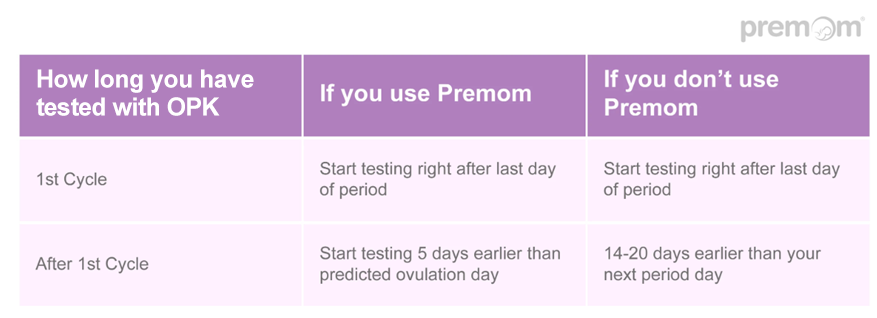
If you have irregular cycles, ovulation may not occur on the same day each cycle. Start testing earlier, continue testing longer, and focus on identifying patterns instead of relying on predicted dates.
5. When is the Best Time to Take an Ovulation Test?
Test any time between the hours of 10:00 AM – 8:00 PM, as this is when LH levels tend to be highest. You’ll just want to make sure you avoid using first morning urine.
6. How Often Should I Test?
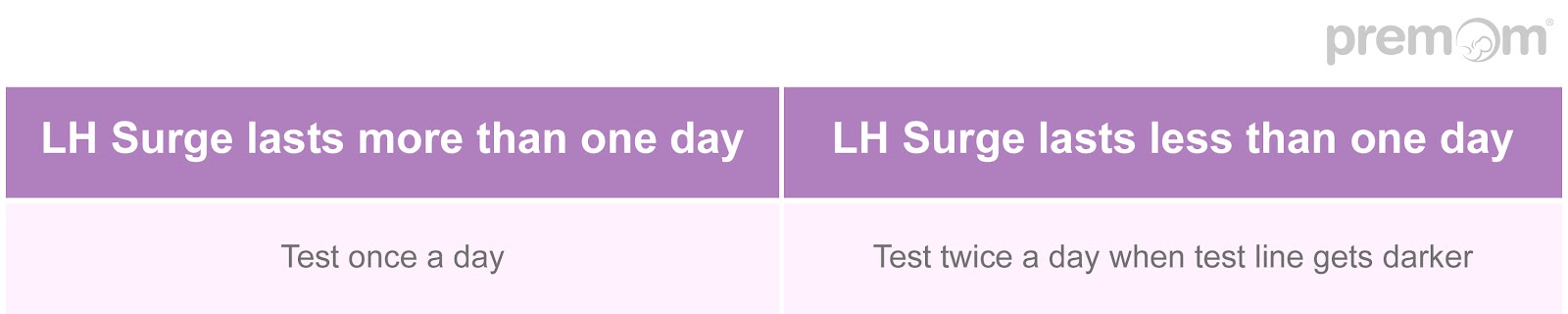
If you are new to ovulation testing, consider testing twice a day to identify if you have a rapid LH surge (LH rising in just a few hours) or a gradual LH surge (LH rising over the course of a few days). Once you know your pattern, you can test once a day if your LH surge lasts more than one day, but twice a day if your surge is less than one day.
How Do You Know the Ovulation Test Worked Correctly?
The two most important factors are urine reaction and results interpretation.
Different brands may have different instructions for urine handling. However, no matter what the brand, this test will result most accurately if you follow this tip:
Dip the white absorbent tip of the test into the urine up to the black “MAX” line and keep the tip in the urine until the dye rises into the results window. (Estimated time for Easy@Home brand: 5-10 seconds)
Why would an ovulation test not work?
Sometimes, you may not get clear or expected results from an ovulation test. This does not always mean there is a problem with your cycle. It may be due to common usage mistakes or testing conditions.
Here are some practical troubleshooting tips to improve accuracy:
- Do not test with your early morning urine, as your LH levels may still be low
- Avoid diluted urine by limiting excessive fluid intake before testing
- Try to test at the same time each day for more consistent results
Following these steps can help you better detect your LH surge and identify your fertile window more accurately.
Ovulation Test Instructions – Do’s and Don’ts



How to Use Ovulation Test – FAQ
The T/C ratio is a comparison of the color intensity of the test line to the control line on a qualitative ovulation test. A positive ovulation test shows a T/C ratio above 1.0 or higher on the Premom app. If your LH level ratios never reached 1.0 in the previous cycle, Premom adjusts its predictions in the following cycle to look for a positive when greater than 0.5.
In most cases, your LH hormone chart should slowly increase over the course of a few days, ending in a peak and then rapidly declining, or swiftly increasing over the course of one day and then rapidly returning to baseline. Your LH pattern, gradual vs. rapid, will determine what the shape of your LH chart looks like. Some women also may experience a double peak or a plateau pattern before the true LH peak occurs.
Ovulation tests detect the rise in luteinizing hormone (LH) in your urine. This rise is called an LH surge or LH peak, and it occurs before ovulation. When LH levels increase, it signals that your body is preparing to release an egg. A positive result helps identify your fertile window, when your chances of getting pregnant are highest.
It is best to take an ovulation test between 10:00 AM and 8:00 PM, as LH levels are usually higher during the day. Avoid using the first morning urine as LH may not be fully detectable at that time. Testing at the same time each day may help improve accuracy.
Ovulation usually occurs about 24 to 36 hours after the LH surge. It’s important to track your LH surge and time intercourse during this period if you want to increase your chances of conception.
LH stands for luteinizing hormone. It’s produced by the pituitary gland, and when it surges mid-cycle, it signals your ovaries to release an egg. That surge is what ovulation tests measure in your urine, and seeing it rise is how you know your fertile window is opening.
References
- Nedresky D. Physiology, luteinizing hormone. StatPearls – NCBI Bookshelf. https://www.ncbi.nlm.nih.gov/books/NBK539692/. Published September 26, 2022.
- Holesh JE. Physiology, ovulation. StatPearls – NCBI Bookshelf. https://www.ncbi.nlm.nih.gov/books/NBK441996/. Published May 1, 2023.
- Reed BG. The normal menstrual cycle and the control of ovulation. Endotext – NCBI Bookshelf. https://www.ncbi.nlm.nih.gov/books/NBK279054/. Published August 5, 2018.
- Su HW, Yi YC, Wei TY, Chang TC, Cheng CM. Detection of ovulation, a review of currently available methods. Bioeng Transl Med. 2017 May 16;2(3):238-246. doi: 10.1002/btm2.10058. PMID: 29313033; PMCID: PMC5689497.
- Johnson S, Stanford JB, Warren G, Bond S, Bench-Capon S, Zinaman MJ. Increased Likelihood of Pregnancy Using an App-Connected Ovulation Test System: A Randomized Controlled Trial. J Womens Health (Larchmt). 2020 Jan;29(1):84-90. doi: 10.1089/jwh.2019.7850. Epub 2019 Sep 4. PMID: 31483187; PMCID: PMC6983750.
- National Institutes of Health – Research notes that LH surge detection improves timing of intercourse compared to relying only on cycle tracking. https://www.ncbi.nlm.nih.gov/pmc/articles/PMC5689497/