
If you’re reading this, there’s a good chance you’re deep in trying to conceive (TTC) mode, tracking ovulation, learning new acronyms, and wondering what actually can help egg quality, especially over 35. You’re not alone. Many couples face bumps on this road, and there are smart, evidence-informed ways to support your chances. One you’ve probably heard about is CoQ10 for fertility.
Here’s what you need to know: CoQ10 is a naturally occurring antioxidant that powers your cells’ energy production and protects against oxidative stress—two functions that become increasingly important for egg quality as you age. Research shows that taking 200-600 mg daily for at least 8-12 weeks may improve ovarian response and embryo quality, particularly in women with diminished ovarian reserve. While it’s not a guarantee, CoQ10 offers a biologically sound way to support reproductive health, especially if you’re in your mid-30s or preparing for IVF.
Let’s walk through what CoQ10 is, how it may support egg (and sperm) health, what the research really says, how much to take and when, and how to track in the Premom app—so you can make calm, confident decisions.
What is CoQ10 (and why does it matter for fertility)?
Coenzyme Q10 (CoQ10) is a vitamin-like compound your body naturally makes. It powers the tiny “engines” in your cells (mitochondria) that create energy (ATP), and it also works as an antioxidant—think of it as a double-duty helper for both energy and protection.
Why that’s a big deal for eggs:
- Egg cells are energy superusers. They have more mitochondria than almost any other cell type. Maturing an egg, releasing it, and supporting the first days of embryo development all require serious ATP.
- Antioxidant protection matters. As we age, normal wear-and-tear (oxidative stress) increases. Antioxidants like CoQ10 help neutralize that stress before it can damage delicate cell structures—like the cell’s spindle (needed for proper chromosome separation) and mitochondrial DNA.
CoQ10 helps eggs make energy and shields them from oxidative stress—two key needs that become more important with age. Research suggests potential benefits for ovarian function, oocyte/embryo quality, and IVF outcomes.
Does CoQ10 improve egg quality after 35?
Research suggests CoQ10 may support egg quality as you age by addressing two key challenges: declining mitochondrial efficiency and increased oxidative stress. Here’s why this matters after 35:
We’re all born with a fixed egg supply, and that reserve naturally declines over time. Quantity drops—and quality can shift too. For many women, cycles are still perfectly capable of pregnancy after 35; it just may take longer, and supporting egg health becomes a smart strategy.
Here’s the simple story:
- Energy demand goes up, but mitochondrial efficiency can go down with age.
- Oxidative stress goes up, while our internal antioxidant defenses aren’t quite as zippy as they used to be.
- CoQ10 levels subtly decline with age, which is one reason supplementation is being studied in fertility. Reviews highlight its role in mitochondrial function and potential to improve oocyte competence.
How CoQ10 may help improve egg quality
1) Energy support for maturing eggs
CoQ10 sits inside the mitochondrial electron transport chain (the ATP assembly line). More efficient energy production may support:
- Follicle development
- Final egg maturation (meiosis)
- The earliest cell divisions after fertilization
2) Antioxidant protection
CoQ10 helps mop up excess reactive oxygen species (ROS), and it also recycles other antioxidants (like vitamins C and E). That teamwork may help protect egg structures and DNA—both in the oocyte and its mitochondria. Some studies point to decreased oocyte DNA damage and better embryo potential when oxidative stress is tempered.
Bottom line: By supporting energy and buffering stress, CoQ10 offers a reasonable, biology-based way to support egg health—especially useful as we move through our mid-30s and 40s. (It’s not a guarantee, but it’s a thoughtful lever that may be worth a try.
Does CoQ10 actually work to support fertility?
- Mechanism & rationale: Multiple reviews summarize how CoQ10 may protect ovarian function and oocyte quality via mitochondrial and antioxidant effects—particularly relevant for ovarian aging.
- IVF/ART preparation: An updated narrative review (2024) notes CoQ10 pretreatment may improve ovarian response and embryo quality in women with weaker ovarian reserve, with positive signals for clinical pregnancy in some studies. More large RCTs are still needed, but the trend is encouraging.
Reality check: Most data is promising but not perfect. We have plausible mechanisms + supportive studies and reviews. The clinical gold standard is still being built—so think “evidence-informed helper,” not “magic pill.”
How much CoQ10 can you take for fertility?
Always talk to your healthcare provider before starting any supplement—especially if you take blood thinners, thyroid meds, or statins.
Forms:
- Ubiquinone (oxidized form)
- Ubiquinol (reduced, “active” form)
Both can work. Some clinicians prefer ubiquinol after 35 because it’s more readily absorbed in certain individuals, but the cost is higher. If you choose ubiquinone, you can still get good results with a consistent, food-with-fat routine.
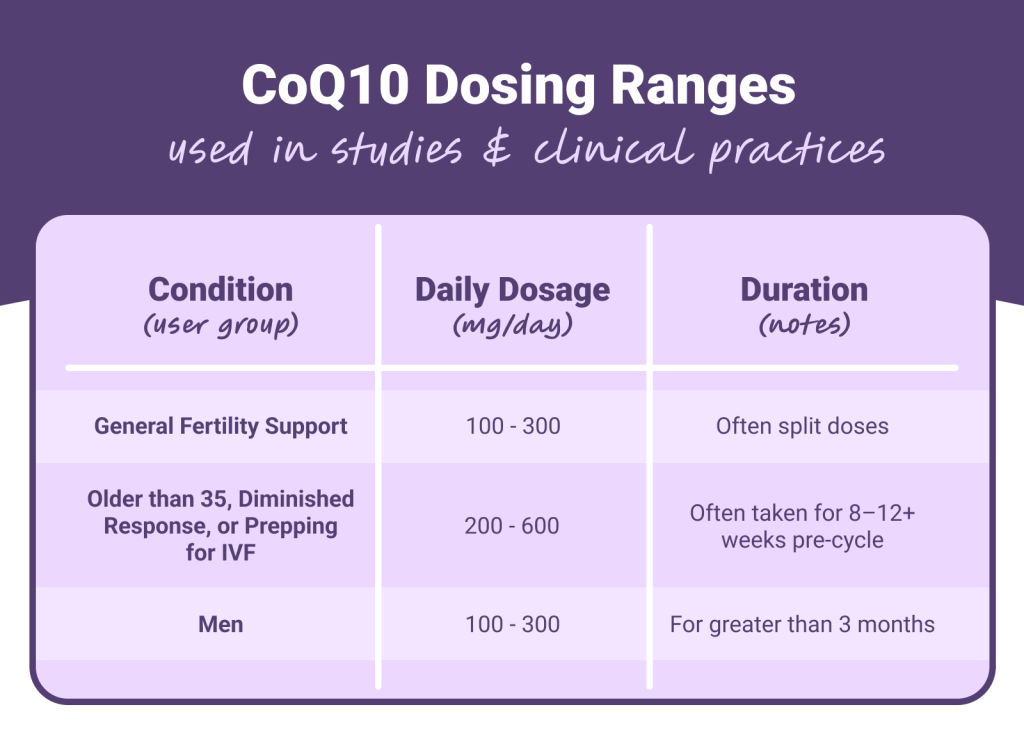
Your provider may tailor this based on your history. Ranges reflect patterns in the literature; however, it is always best to go with what your provider suggests for your unique needs.
Tips for Taking CoQ10:
- Start Early: For the best results, start taking CoQ10 at least three months before trying to conceive or starting fertility treatments. This gives the supplement time to support the full 90-day cycle of egg development.
- Ubiquinol vs. Ubiquinone: You’ll see CoQ10 sold as two forms. After age 35, your body finds it harder to use the ubiquinone form. The ubiquinol form is already active and up to 70% easier to absorb.
- Take It With Food: Your body absorbs CoQ10 much better when you take it with fatty meals.
- Track With An App: Apps like Premom can help you track your supplement routine alongside cycle data—logging when you take CoQ10, monitoring cycle changes over a 3-month period, and identifying your fertile window with LH testing and BBT tracking.
Is CoQ10 Safe?
CoQ10 is generally well-tolerated with minimal side effects. Some people may experience mild stomach issues like nausea or diarrhea. If you experience any unusual symptoms, consult with your healthcare provider. Always discuss supplements with your doctor before starting, especially if you take blood thinners, thyroid medications, or statins.
CoQ10’s Teamwork
Recent research shows that CoQ10 often works even better when taken with other supplements. Ask your doctor about a combination, such as CoQ10 paired with:
- Melatonin or DHEA: These combinations can boost the number of eggs collected and improve the quality of embryos.
- Vitamin E: These two antioxidants work together to create a stronger defense system against damage.
Can CoQ10 Help Male Fertility Too?
Fertility is a shared journey, and supporting sperm health matters just as much as egg quality. In fact, nearly 40–50% of fertility challenges involve a male factor, often related to oxidative stress or reduced sperm motility.
Just like eggs, sperm cells need a steady supply of energy from their mitochondria to swim, fertilize, and deliver healthy DNA to the egg. That’s where CoQ10—especially in its active Ubiquinol form—comes in.
Why CoQ10 Matters for Men
CoQ10 is highly concentrated in the midpiece of sperm cells, right where the mitochondria live. Its job is twofold:
- Fuel: It boosts ATP production to power stronger, more sustained sperm movement (motility).
- Protection: It defends sperm DNA from oxidative damage that can lead to poor morphology or lower fertilization rates.
Multiple clinical studies show that men who supplement with CoQ10 experience measurable improvements in sperm motility, count, and DNA integrity within 8–12 weeks. This makes it one of the most researched nutrients for male fertility support.
Because a full sperm cycle takes 70-90 days, consistent supplementation matters. Many men find that comprehensive formulas combining Ubiquinol (the active CoQ10 form) with synergistic nutrients like zinc, selenium, and L-carnitine offer a more complete approach than standalone supplements.
Premom Sperm Fortify, for example, contains 150 mg of Ubiquinol along with other research-backed nutrients that support sperm energy and DNA protection. For couples taking the fertility journey together, Premom’s Predad™ feature helps male partners stay engaged with cycle date visibility, fertile window reminders, and educational insights about male and female fertility.
Frequently asked questions about CoQ10 for fertility
It won’t add to your lifetime egg count, but reviews suggest it may support egg quality by improving mitochondrial function and reducing oxidative stress—especially relevant with ovarian aging.
Plan on 8–12 weeks minimum before expecting to notice changes, and ~3 months if you want sperm and egg support.
Both forms can help. If cost allows, many people 35+ choose ubiquinol for absorption.
Yes—reviews show improved semen parameters (motility, count). Some newer data suggest better clinical pregnancy rates in idiopathic male infertility when used ≥3 months, but more RCTs are needed to confirm live-birth effects.
Generally considered well-tolerated. Always clear supplements with your REI/OB-GYN to avoid interactions and to tailor dose/timing to your protocol.
References
Florou, P., Anagnostis, P., Liberopoulos, E., & Karachalios, A. (2020). Does coenzyme Q10 supplementation improve fertility outcomes? A comprehensive review. Archives of Endocrinology and Metabolism, 64(6), 624–635. https://doi.org/10.20945/2359-3997000000287
Alexandru, I., Murgu, A. I., & Scupola, M. A. (2024). Vitamins, coenzyme Q10, and antioxidant strategies to improve oocyte competence: A narrative review. Antioxidants, 13(12), 1567. https://doi.org/10.3390/antiox13121567
Lin, G., Wang, X., & Yang, H. (2024). Clinical evidence of coenzyme Q10 pretreatment for female infertility: From mechanisms to applications. Annals of Medicine, 56(1), 1–12. https://doi.org/10.1080/07853890.2024.2389469
Yang, L., Luo, R., & Zhang, J. (2022). Systematic understanding of anti-aging effect of coenzyme Q10 on oocytes via network pharmacology and molecular docking. Frontiers in Endocrinology, 13, 813772. https://doi.org/10.3389/fendo.2022.813772
Bakri S, Saleh R, Cayan S, Birowo P, Atmoko W, Zainal ATF, Makkaraka MAG, Agarwal A. Efficacy and Safety of Coenzyme Q10 in Idiopathic Male Infertility: A Systematic Review and Meta-Analysis of Randomized Trials. World J Mens Health. 2025 Aug 27. doi: 10.5534/wjmh.250159. Epub ahead of print. PMID: 40878114.
Alahmar AT. The impact of two doses of coenzyme Q10 on semen parameters and antioxidant status in men with idiopathic oligoasthenoteratozoospermia. Clin Exp Reprod Med. 2019 Sep;46(3):112-118. doi: 10.5653/cerm.2019.00136. Epub 2019 Aug 14. PMID: 31408928; PMCID: PMC6736512.
Banihani, S. A. (2021). Coenzyme Q10 and male infertility: A systematic review. Antioxidants, 10(6), 874. https://doi.org/10.3390/antiox10060874
Jiang Y, Han Y, Qiao P and Ren F (2025) Exploring the protective effects of coenzyme Q10 on female fertility. Front. Cell Dev. Biol. 13:1633166. doi: 10.3389/fcell.2025.1633166
Xuanling Li, Qian Zhao, Guangyao Lin & Lianwei Xu. (2025) The auxiliary effect of oral nutritional supplements on fertility in women with diminished ovarian reserve: a systematic review and meta-analysis. Annals of Medicine 57:1.


