

If you’re trying to conceive, understanding your chances of getting pregnant after ovulation is a common concern. Knowing when you ovulate and timing intercourse around this window can significantly increase your chances of conceiving. Here’s what you need to know about the days following ovulation and how they impact your fertility journey.
Can You Get Pregnant After Ovulation?
Yes, you can get pregnant after ovulation, but the window of opportunity is brief. The best chances of conception occur when sperm meets an egg within 24 hours after it is released from the ovary. If you’re not certain about the exact timing of ovulation, or if ovulation has not been confirmed, your chances could vary. This is why it’s essential to track ovulation accurately, so you know when you’re most fertile and maximize your chances of pregnancy.
How Long After Ovulation Can You Get Pregnant?
After ovulation, the egg remains viable for up to 24 hours. This short window is when conception is most likely to happen if there is sperm present to fertilize the egg. Sperm, however, can live in the female reproductive tract for up to five days, which is why having sex in the days leading up to ovulation, as well as on the day of ovulation, gives you the best chance of getting pregnant. If you’re trying to conceive, aim to have intercourse during this fertile window to boost your chances!
Chances of Pregnancy in Relation to Ovulation Day
The chances of getting pregnant are highest during the days leading up to and including ovulation day. Here’s a breakdown of approximate conception chances depending on how close you are to ovulation day*:
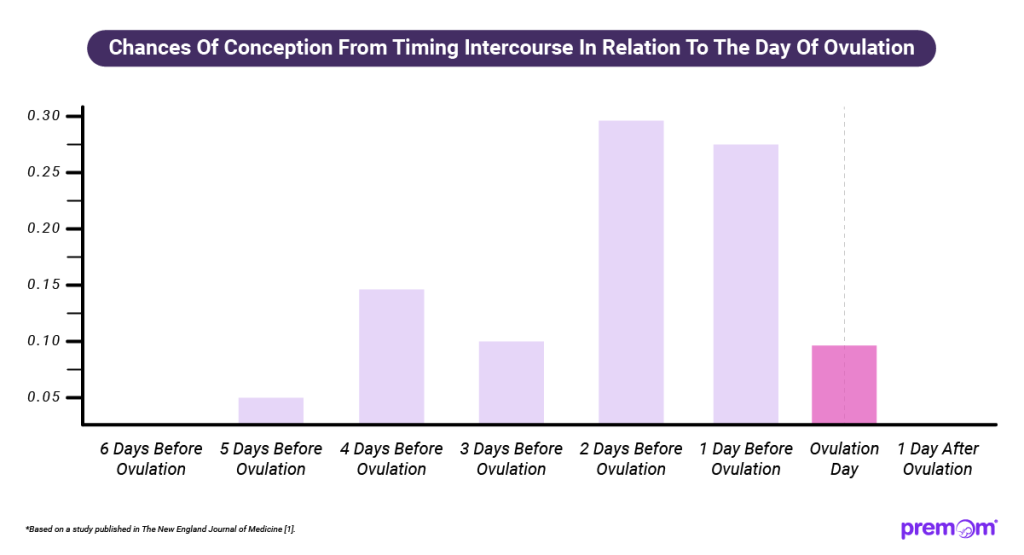
Best Days for Conception: Your peak fertility days are the 2 days before ovulation and on the day of ovulation itself. Try to time intercourse around these days to maximize your chances!
Common Misconceptions About Pregnancy and Ovulation
There are two common misconceptions when it comes to getting pregnant:
- “You can get pregnant at any time during your cycle.”
Actually, the chances of getting pregnant outside of the fertile window are near impossible. Conception is most likely to occur when intercourse happens during the 5 days leading up to and including ovulation. - “Ovulation always happens on cycle day 14.”
This is a myth. Every woman’s cycle is different. Ovulation day can vary based on your cycle length, stress levels, and overall health. That’s why tracking your cycle is key. We recommend the Premom app to help you accurately track ovulation and identify your fertile days.
How to Track Ovulation and Calculate Your Fertile Window
Tracking ovulation is one of the best ways to know your most fertile days. You can track your cycles with methods like ovulation predictor kits (OPKs), monitoring basal body temperature (BBT), or observing changes in cervical mucus.
But the Premom app makes it even easier to know when the best time to get pregnant is with our 3-step approach:
- Track your cycles using ovulation tests or basal body temperature in Premom
- Keep testing until the Premom app detects your ovulation test peak (LH peak) or BBT Spike
- Have intercourse on a peak fertility day or ovulation day (and remember to log it in the app!)

The app’s “Cycle Status” feature uses an easy-to-understand color system to show you how to increase your chances of getting pregnant each cycle. As you continue to track ovulation and progress, you’ll achieve different statuses, each representing a step closer to your optimal pregnancy chances. The goal is to reach the Green Cycle status, which gives you the highest chance of getting pregnant while using Premom.
In fact, our recent study found that women who achieved Green Cycles had a 287% higher pregnancy rate than those who only were logging their period! We are making a smarter, stress-free way to help you feel more confident and in control of your fertility journey.
What Are the Signs That Ovulation Is Over?
Recognizing when ovulation has ended can help you understand your cycle better. Signs ovulation is over may include a negative result on an ovulation test (OPK), changes in cervical mucus (becoming thicker or dry), and a rise in basal body temperature. Other physical signs might include changes in breast tenderness or mild cramping.
What to Avoid After Ovulation to Improve Pregnancy Chances
After ovulation, if you’ve timed intercourse in your fertile window, there’s a chance that fertilization and implantation may already be happening. This period, often referred to as the two week wait, is a crucial time. During the two week wait, consider avoiding new strenuous exercises, excessive caffeine, and alcohol, which could potentially affect implantation. Focus on maintaining a healthy lifestyle with proper nutrition, hydration, and stress management to support early pregnancy and your overall health.
Your journey to conception is unique, and understanding your fertile window is a crucial step in that process. By accurately tracking ovulation, using tools like the Premom app, and timing intercourse wisely, you’re giving yourself the best chance of getting pregnant. Keep your spirits high and know that every cycle brings new hope!
FAQs About Getting Pregnant After Ovulation
How long after ovulation can you conceive?
You can conceive for up to 24 hours after ovulation, as this is the window when the released egg is viable for fertilization.
However, sperm can live in the reproductive tract for up to five days, which means conception is most likely if intercourse occurs in the days leading up to ovulation and on the day of ovulation itself.
Is it possible to get pregnant outside the fertile window?
It’s highly unlikely to get pregnant outside the fertile window. Sperm can live up to 5 days in the reproductive tract, so intercourse leading up to ovulation can result in pregnancy. However, intercourse happens too far outside the fertile window, and the chances of conception are very low because the sperm and egg are unlikely to meet.
How long after ovulation can you take a pregnancy test?
You can take a pregnancy test around 12-14 days after ovulation when hCG levels are detectable.
Can you get pregnant 2 days after ovulation?
It’s unlikely to get pregnant 2 days after ovulation since an egg is typically viable for only 24 hours after being released. After this time, chances of fertilization drop significantly.
References
- Wilcox AJ, Weinberg CR, Baird DD. Timing of sexual intercourse in relation to ovulation. Effects on the probability of conception, survival of the pregnancy, and sex of the baby. N Engl J Med. 1995 Dec 7;333(23):1517-21. doi: 10.1056/NEJM199512073332301. PMID: 7477165.
- Wilcox AJ, Dunson D, Baird DD. The timing of the “fertile window” in the menstrual cycle: day specific estimates from a prospective study. BMJ. 2000;321(7271):1259-1262. doi:10.1136/bmj.321.7271.1259
- Holesh JE, Bass AN, Lord M. Physiology, ovulation. StatPearls – NCBI Bookshelf. Published May 1, 2023. https://www.ncbi.nlm.nih.gov/books/NBK441996/
- Oliver R, Basit H. Embryology, fertilization. StatPearls – NCBI Bookshelf. Published April 17, 2023. https://www.ncbi.nlm.nih.gov/books/NBK542186/
- Understanding Ovulation and the Fertile Window.; 2021. https://www.fertilitysociety.com.au/wp-content/uploads/Understanding-ovulation-and-the-fertile-window.pdf